
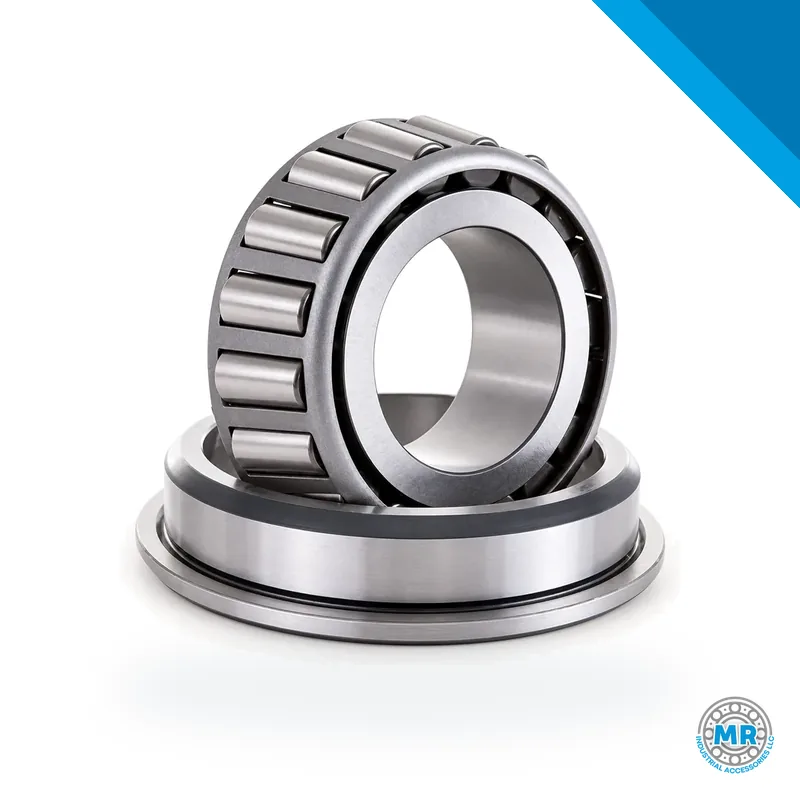

SKF L 814749/710/QCL7C tapered roller bearing
- Brand
- SKF
- Category
- Bearings
- Subcategory
- Tapered roller bearings
We reply promptly.
Tell us the quantity you need and request a quote by WhatsApp or email.
Other brands for this category
Ask us for alternatives. We check every equivalent against the part number and your application.
Can't find the exact model? Tell us the part number or model you need. We'll track it down and quote it, whether or not it appears in our catalog.
Description
SKF L 814749/710/QCL7C belongs to tapered roller bearing, part of our Bearings range. Tell us how many you need by WhatsApp or email and we'll get back to you promptly with a quote for L 814749/710/QCL7C and any equivalents.
SKF tapered roller bearings are separable: a cone assembly (inner ring, rollers, cage) and a cup (outer ring). This design allows them to take both radial and axial forces, which is why they show up in gearboxes, wheel hubs and transmission equipment. They are usually installed in face-to-face pairs so that axial load can be absorbed in either direction.
The part number tells you what you are holding. Take L 814749/710/QCL7C: the L prefix and 814749 point to the series, while 710 is the bore code. In tapered roller bearings the designation typically has two numbers separated by a slash—the first for the cone, the second for the cup. To order a replacement, just give us the full code exactly as it appears on the drawing or on the bearing itself.
These bearings are common in gearboxes, reducers, road machinery axles, earthmoving equipment, mills, conveyor belts and kiln rollers. You will also find them in agricultural equipment such as seeders and harvesters, as well as in railway and port operations. Because they handle combined loads, they suit shafts where the load is not purely radial.
Selecting the right bearing means looking at the radial and axial loads, the rotation speed and the space available. Mounting involves a fit on both the cone and the cup; heavier loads call for more interference. Alignment between the two rings is critical—check that the shoulder is perpendicular and use the proper tools to avoid damaging the rollers. Grease or oil lubrication works, depending on the application and the thermal conditions.
When comparing cross-references, focus on the main dimensions (bore diameter, outer diameter and width) and the load capacity. Manufacturers may have their own naming systems, but the same series code generally keeps the same dimensions. If you have a part number from another brand or an unidentified bearing, send us the details and we will identify a compatible alternative.
Dimensions
Dimensions and tolerances: Message us the part number on WhatsApp and we'll verify its dimensions and version with the manufacturer's datasheet.
Frequently asked questions
- What kind of loads can a tapered roller bearing handle?
- It is built for combined radial and axial loads. How much axial load it can take depends on the contact angle and the mounting arrangement; face-to-face pairs are common to manage forces in both directions.
- How should a tapered roller bearing be mounted?
- It is mounted with a fit on the cone and on the cup. The two rings must be precisely aligned and the shoulders perpendicular. Follow the manufacturer's recommendations for fit and lubrication.
- What do I need to provide to get a quote?
- Send the complete code from the part or drawing, or the main dimensions: bore diameter, outer diameter and width. With that information we can quote the exact reference on WhatsApp.