
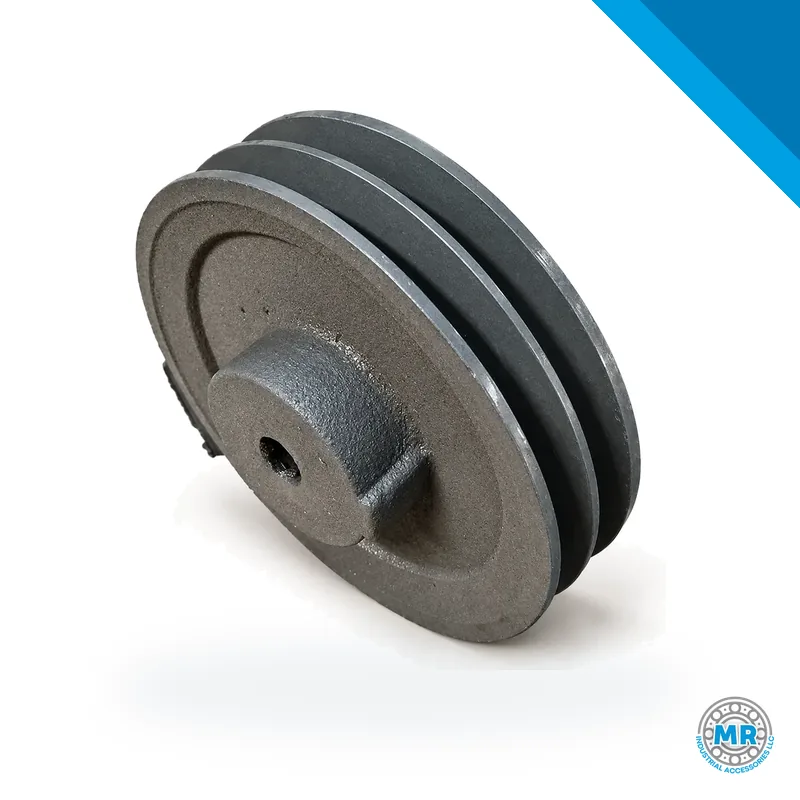

Industrial pulley 140 mm, 2 grooves, section B
- Brand
- EMMAR
- Category
- Power transmission
- Subcategory
- Pulleys
- Section
- B
- Series
- Sección B
We reply promptly.
Tell us the quantity you need and request a quote by WhatsApp or email.
Can't find the exact model? Tell us the part number or model you need. We'll track it down and quote it, whether or not it appears in our catalog.
Description
EMMAR POLEA 140 2B belongs to pulleys, part of our Power transmission range. Tell us how many you need by WhatsApp or email and we'll get back to you promptly with a quote for POLEA 140 2B and any equivalents.
The EMMAR PULLEY 140 2B is a power transmission pulley manufactured in-house by MR. It features a 140 mm diameter and two grooves for section B belts. This pulley is designed to drive shafts and equipment from a motor, serving as a critical component in any transmission line. Because it is produced domestically, dimensions and finishes can be tailored to specific equipment requirements. Whether you are assembling a new transmission or replacing an existing pulley, this model provides a reliable foundation for your installation.
The designation PULLEY 140 2B encapsulates three key specifications: a 140 mm diameter, two grooves, and section B compatibility. Section B is widely used in medium industrial transmission, and the two grooves allow for load distribution across two belts. This configuration defines how many belts can be mounted and the profile that fits each groove. As an in-house manufactured EMMAR brand part, it is suited for integration into new equipment or as a replacement in existing systems.
Typical applications for this pulley include transmission lines in workshops, plants, and process equipment such as fans, compressors, pumps, conveyor belts, and machine tools. It is also found in agricultural implements and material handling equipment. In all cases, the pulley mounts on a shaft and receives the belt from the drive pulley. The two-groove design is often chosen for transmissions where greater grip or continuity of operation is desired if one belt fails.
When selecting and mounting this pulley, consider the outside diameter, number of grooves, and belt section. Verify that the shaft and keyway match the pulley bore, and ensure alignment with the drive pulley is square to prevent uneven wear. Belt tension is also critical: too loose causes slipping, while too tight strains bearings. For transmission ratio calculations, start with the pulley diameters and motor speed.
If PULLEY 140 2B is not exactly what you need, we can help you find an equivalent. Provide the diameter, number of grooves, section, and if possible, a photo or drawing of the shaft. With that information, we can review which in-house manufacturing option fits best. We can also evaluate special finishes or machining based on your application. The goal is to ensure the pulley fits your equipment without odd adaptations or downtime.
To request a quote for this pulley or inquire about a variant, send the part number PULLEY 140 2B via WhatsApp or email. If you are unsure about the section or number of grooves, contact us anyway; we can help confirm the correct option before manufacturing. We handle technical inquiries Monday through Friday and serve customers across the United States and in several Latin American countries.
Dimensions
- Size
- 140mm
- Grooves
- 2
- Section
- B
Frequently asked questions
- What does PULLEY 140 2B mean?
- The part number indicates a pulley with a 140 mm diameter, two grooves, and section B. Section B defines the belt profile that fits each groove. The two grooves allow two belts to be mounted, distributing the load in the transmission.
- How do I request a pulley with another size or number of grooves?
- Send the diameter, number of grooves, and section you need via WhatsApp or email. If you have the old part number or a photo of the pulley, that helps. With that data, we can indicate the custom manufacturing that applies.
- What should I check before mounting it?
- Check that the bore and keyway match the shaft, that alignment with the drive pulley is correct, and that belt tension is adequate. Poor alignment or tension wears out belts and the equipment's bearings.