
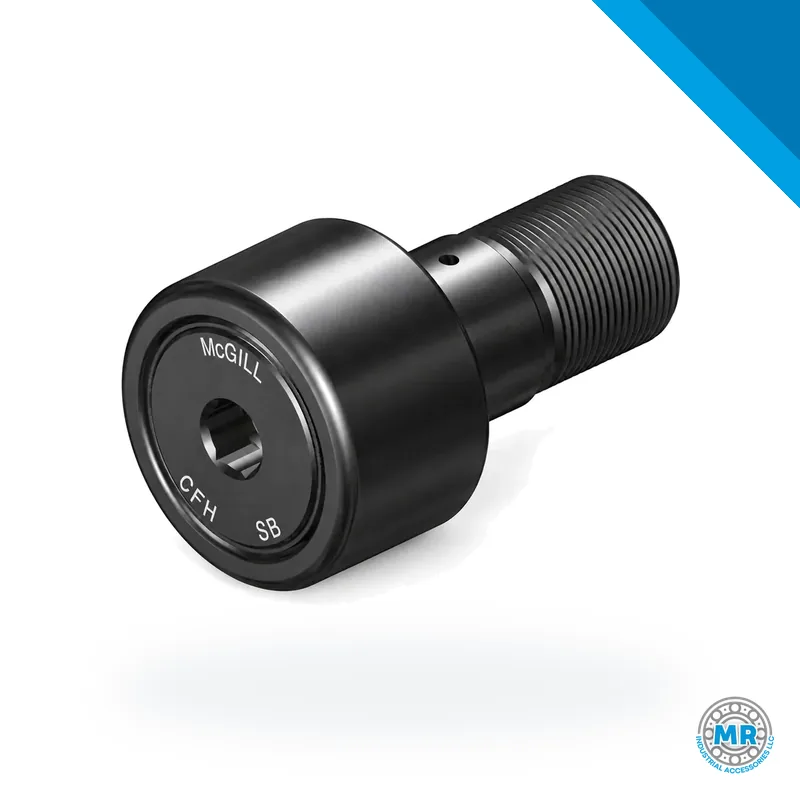

MCGILL CCF 1/2 N cam follower
- Brand
- McGILL
- Category
- Bearings
- Subcategory
- Cam follower and support roller
We reply promptly.
Tell us the quantity you need and request a quote by WhatsApp or email.
Can't find the exact model? Tell us the part number or model you need. We'll track it down and quote it, whether or not it appears in our catalog.
Description
McGILL CCF 1/2 N belongs to cam follower, part of our Bearings range. Tell us how many you need by WhatsApp or email and we'll get back to you promptly with a quote for CCF 1/2 N and any equivalents.
The McGill CCF N series cam follower is a roller bearing built to carry radial loads in applications that run on cams and raceways, whether the motion is reciprocating or continuous. MR Industrial Accessories supplies this line as part of a catalog that also covers mounted units, power transmission components, seals and maintenance tools, serving customers throughout the United States and in several Latin American countries.
Reading the code helps you narrow down the options before you order. In the CCF N designation, CCF identifies the McGill cam follower family, while the trailing N points to a particular configuration within the series, typically tied to the seal type or the stud shape. The number in the middle gives the nominal roller diameter in inches: CCF 1/2 N and CCF 5/8 N correspond to 1/2 inch and 5/8 inch rollers. With that logic, matching a replacement to the space available on the machine becomes straightforward.
These cam followers show up in cam systems on machine tools, linear guides in packaging equipment, chain conveyors, presses, punching machines and lifting mechanisms. They mount directly on shafts or studs, which makes the conversion between rotary and reciprocating motion simple to set up. Industries such as automotive, food processing, metallurgy and plastics rely on them where repetitive loads and harsh working conditions are part of daily operation.
Selection comes down to four points: roller diameter, seal type for the surrounding environment (dust, moisture, temperature), radial load capacity and rotation speed. The shaft must have the correct fit and be precisely aligned, otherwise wear appears early. Lubrication also matters, so confirm whether the unit has a grease fitting or can be relubricated at intervals. In contaminated areas, versions with lip seals or extra protection are the better choice.
For interchangeability, cam followers from other brands that follow the same inch nomenclature, such as comparable INA, SKF or NTN series, may work as substitutes when roller dimensions, stud diameter and seal type line up. Tolerances and load capacity should be checked before making a swap, since small differences can change performance. Our team can review your application and point you to a suitable alternative.
To request a quote, send the exact part number from your equipment or drawing by WhatsApp or email. If the number is unclear, a photo or the main dimensions are enough for us to help identify the correct variant. We also suggest equivalents and assist with product selection.
Dimensions
Dimensions and tolerances: Message us the part number on WhatsApp and we'll verify its dimensions and version with the manufacturer's datasheet.
Frequently asked questions
- What does the N indicate in the CCF N series?
- The final N refers to a specific configuration within the CCF series, usually related to the seal type or the stud shape. Send us the full model on WhatsApp and we will confirm the exact feature of your part number.
- How do I pick the right cam follower size?
- Look at the roller diameter (1/2 inch or 5/8 inch, for example), the radial load, the rotation speed and the working environment. With those details we can recommend the appropriate part number within the CCF N series.
- Can these cam followers replace units from other brands?
- They may interchange with cam followers from other brands that use the same inch dimensions and seal type. Verify tolerances and load capacity first. Our team can advise you on a safe substitution.