
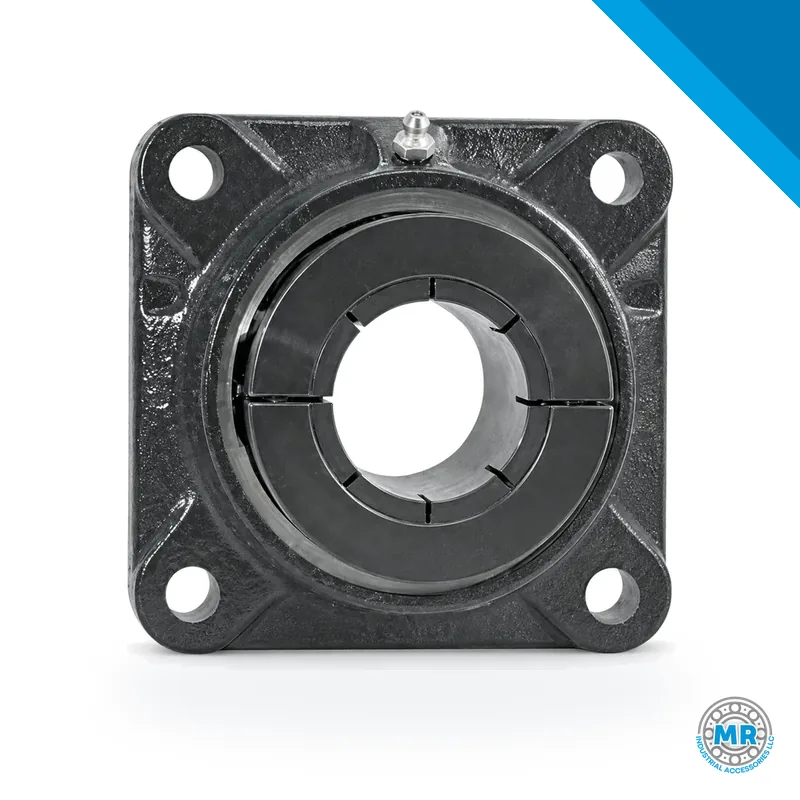

LINK-BELT F3CL2E20N flange bearing 4 holes
- Brand
- LINK-BELT
- Category
- Bearing housings
- Subcategory
- Bearing housings
- Series
- CL
We reply promptly.
Tell us the quantity you need and request a quote by WhatsApp or email.
Can't find the exact model? Tell us the part number or model you need. We'll track it down and quote it, whether or not it appears in our catalog.
Description
LINK-BELT F3CL2E20N belongs to flange bearing 4 holes, part of our Bearing housings range. Tell us how many you need by WhatsApp or email and we'll get back to you promptly with a quote for F3CL2E20N and any equivalents.
When a shaft needs firm, centered support on a flat surface, a four-bolt flange bearing is often the practical answer. The LINK-BELT CL series mounts directly onto sheet metal or structural steel and keeps the shaft aligned in conveyors, mixers, pumps and similar equipment. MR Industrial Accessories supplies this line and helps you match the right unit to your shaft and mounting pattern.
Reading the code takes a moment, but it pays off. In the CL family, the leading F tells you the housing is a flange type. The digits that follow CL correspond to the shaft size, and the closing letters or symbols point to sealing and locking choices. Take F3CL2E20N, F3CL2E26N and F3CL2E32N: all three belong to the same line, yet the middle figure is what decides whether the bore suits your shaft. Any suffix such as N, or the Δ■ marks, flags a build option that should be verified against the complete part number before ordering.
On the plant floor, these units turn up on belt conveyors, bucket elevators, horizontal mixers, centrifugal pumps and other process machinery. The four-bolt pattern lets you bolt the housing flat to plate or frame, which simplifies the first alignment pass. Food, chemical and aggregate operations favor them because the assembly stays compact while carrying radial load along with a degree of axial load.
Choosing the right variant comes down to three checks: shaft diameter, how the housing is mounted, and the conditions around it. Dusty or damp areas call for a version with heavier sealing. If the equipment runs hot, look at the lubrication and internal clearance instead. At installation, set the flange on a clean, level surface, draw the four bolts down in a cross sequence, and spin the shaft by hand to confirm it turns freely before you start the drive.
Flange bearings from different makers each follow their own naming logic, so a swap is never automatic. Bore size, bolt hole spacing, overall height and seal design all have to line up. Other lines may offer a match for the LINK-BELT CL series, but the final call rests on measuring the equipment itself. MR Industrial Accessories points you to a compatible option that keeps the application running as intended.
Dimensions
- Bore
- 1 1/4 in
Frequently asked questions
- How can I tell which shaft size a LINK-BELT CL series bearing fits?
- Look at the figure placed after CL in the part number. In F3CL2E20N, that figure is 20, which corresponds to the shaft dimension. Confirm it against the measured shaft and the flange hole spacing before ordering.
- What do the F prefix and the N suffix indicate?
- The F at the start identifies a flange housing. Endings like N, or the Δ■ symbols, point to variations in sealing, locking or material. Because these change from one maker to another, send the complete part number so the right configuration can be confirmed.
- Is it possible to substitute a bearing from another brand with a LINK-BELT CL series unit?
- It can work when shaft diameter, hole spacing and mounting height are the same. A similar series name is not enough; the physical measurements must be compared. MR Industrial Accessories helps you locate the equivalent that fits.