
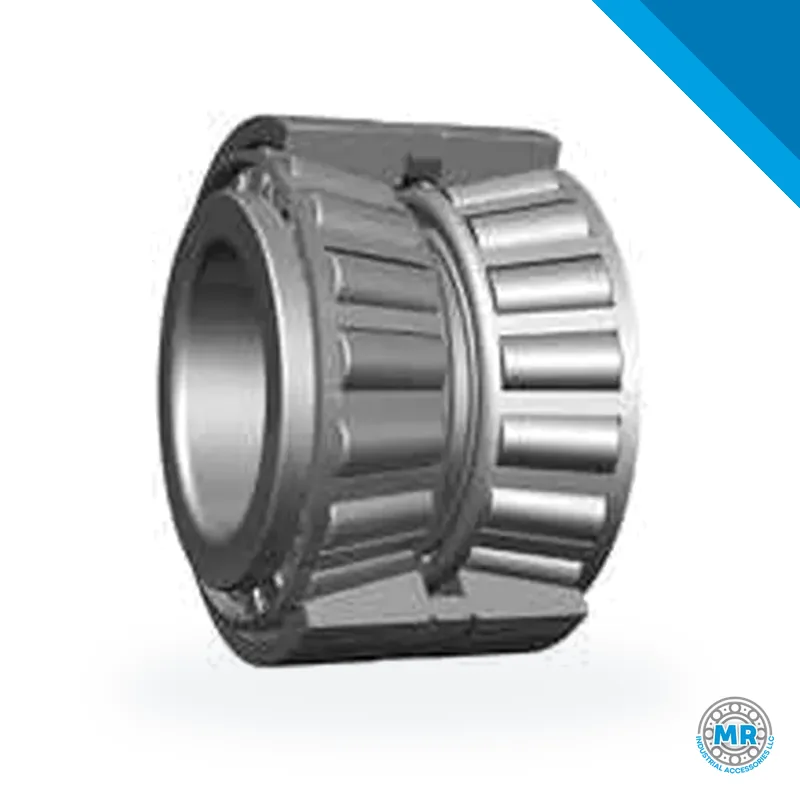

TIMKEN M822010EA tapered roller bearing de doble hilera
- Brand
- TIMKEN
- Category
- Bearings
- Subcategory
- Tapered roller bearings
- Series
- 2TS-DM
We reply promptly.
Tell us the quantity you need and request a quote by WhatsApp or email.
Can't find the exact model? Tell us the part number or model you need. We'll track it down and quote it, whether or not it appears in our catalog.
Description
TIMKEN M822010EA belongs to tapered roller bearing de doble hilera, part of our Bearings range. Tell us how many you need by WhatsApp or email and we'll get back to you promptly with a quote for M822010EA and any equivalents.
Two rows of tapered rollers sharing one shaft: that is the basic layout of the TIMKEN 2TS-DM and 2TS-IM series. This design takes combined radial and axial forces from either direction and is built for rigidity and precision, which is why it turns up in gearboxes, mining machinery, steel operations and other heavy equipment. MR Industrial Accessories LLC supplies these bearings to customers throughout the United States and in several Latin American countries.
Reading the code is the first step in identifying a bearing. Take M349510EA, M612910EA or M822010EA: the M at the front marks the dimension series, the digits that follow place the size inside that series, and the EA ending points to a specific execution tied to internal design and load capacity. The 2TS-DM and 2TS-IM series cover double row arrangements that differ in how they mount. Manufacturer designation tables are the reliable way to decode any code.
Typical service locations include mining equipment, steel plants, mills, conveyor belts and cement machinery, along with speed reducers and machine tool spindles where rigidity matters. Because the bearing handles combined loads, it suits positions where axial forces act in both directions, such as backup rolls in rolling mills or the slewing systems of large structures.
Selection starts with radial and axial load, rotation speed and the surrounding environment. During mounting, alignment and internal clearance adjustment are critical; lock nuts or shims usually set the clearance. Grease or oil both work for lubrication, depending on speed and operating temperature, and seals or extra protection help in dusty or wet locations. Manufacturer instructions for mounting and commissioning should be followed.
Replacement searches often involve comparing designations across brands. Main dimensions may line up while load capacities and suffixes do not, so it pays to check the execution type and internal clearance, not just diameter and width. Interchangeability frequently comes down to confirming the application and service conditions. Our team can help you identify a compatible option for your equipment.
Have the code or model ready and send it to us on WhatsApp or by email. We reply promptly with a quote and, where needed, point you to a compatible alternative. Split plummer block housings, ANSI roller chains and sheaves are also part of our manufacturing program if you need them for the same job.
Dimensions
Dimensions and tolerances: Message us the part number on WhatsApp and we'll verify its dimensions and version with the manufacturer's datasheet.
Frequently asked questions
- What do the parts of a code like M349510EA tell me?
- The leading M is the dimension series, the number that follows gives the size within it, and EA denotes a particular execution that can relate to internal design or load capacity. Designation tables are needed to read each code with certainty.
- When is a double row bearing the better choice over a single row?
- A double row version carries axial loads in both directions and provides more rigidity, which fits applications with substantial combined forces. A single row suits cases where axial loads run one way or stay low. Load, speed and space decide the call.
- What matters most when mounting these bearings?
- Alignment and internal clearance adjustment come first, and lock nuts or shims are the usual way to set clearance. Lubrication has to match speed and temperature, and seals or guards are worth adding in contaminated settings. Following the manufacturer's instructions helps avoid early failures.