
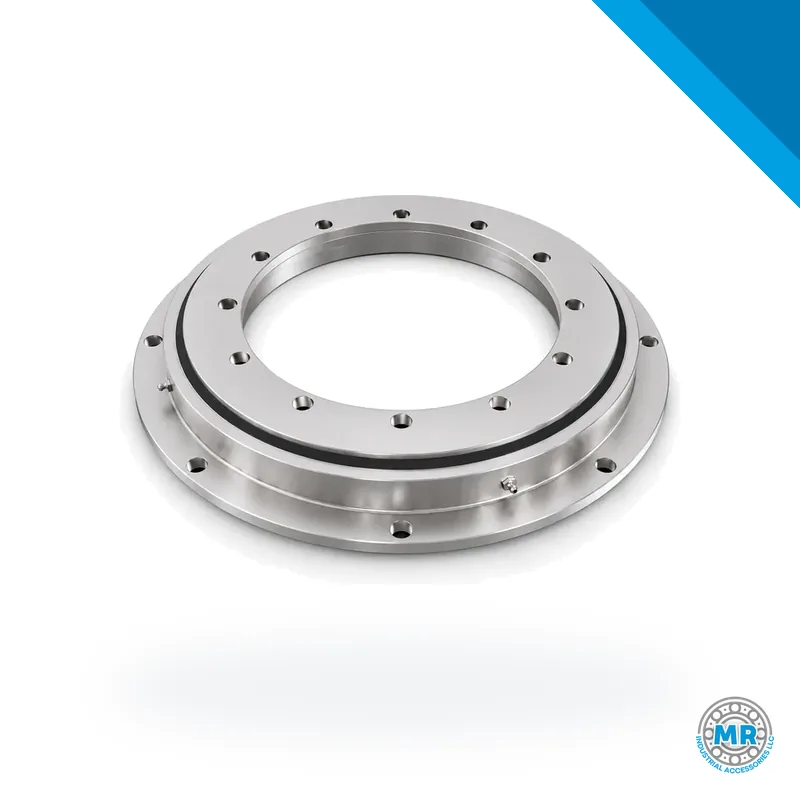

TECMA DRIVE SD.1400.32.00.C slewing ring
- Brand
- TECMA DRIVE
- Category
- Power transmission
- Subcategory
- Slewing rings
- Series
- SD.32.00.C (serie de 32 mm, con brida)
We reply promptly.
Tell us the quantity you need and request a quote by WhatsApp or email.
Can't find the exact model? Tell us the part number or model you need. We'll track it down and quote it, whether or not it appears in our catalog.
Description
TECMA DRIVE SD.1400.32.00.C belongs to slewing ring, part of our Power transmission range. Tell us how many you need by WhatsApp or email and we'll get back to you promptly with a quote for SD.1400.32.00.C and any equivalents.
When two structures have to rotate against each other under combined loads, a TECMA DRIVE slewing ring without gearing does that job. The SD designation tells you there is no gear teeth cut into the ring, so rotation is driven by whatever external mechanism your equipment already uses. MR Industrial Accessories is an official distributor of TECMA DRIVE in the USA.
Reading the code is the fastest way to confirm you are ordering the right ring. The leading letters describe the gearing, and SD means the ring is supplied without it. The number that follows is the ball or roller diameter in millimeters: 20 belongs to the light series, 25 and 32 to the heavier series, and 14 to the crossed-roller versions. A trailing C indicates a flanged design. The complete code is stamped on the nameplate, so copy it exactly when you request a quote. If the plate is worn or painted over, send the outer diameter, inner diameter, overall height and a photo of the gearing area instead, and we can work from those.
These rings turn up in metallurgy, port operations, mining and construction, wherever a structure has to rotate precisely while carrying combined loads. Typical installations include cranes, aerial work platforms, cutting tables and material handling equipment. Because there is no internal gearing, the ring suits systems where the drive comes from a separate source and the movement has to stay smooth and controlled alongside the rest of the power transmission train.
Selection comes down to the mounting conditions. Check the alignment between the two structures, plan the sealing so dust and moisture stay out, and set up a lubrication interval. Verify axial and radial clearance against what the application actually demands. Poor mounting is a common cause of premature wear, so follow the technical instructions and ask us before you commit if anything is unclear.
Equivalents between manufacturers do exist, but the critical dimensions and the load capacity have to be confirmed before anything is replaced. Nomenclature is not shared across brands, so interchangeability needs to be checked against the technical specifications rather than assumed. Send us the part number or model by WhatsApp or email and our team will reply promptly, suggest equivalents where they apply, and help you settle on the right component.
Dimensions
- Gearing
- No gear teeth
- Rolling elements
- Single-row ball, four-point contact
- Ball or roller Ø
- 32mm
- Rings
- Flanged (lightened)
- Material
- Hardened C45Mn steel
Frequently asked questions
- What does the SD prefix indicate on a TECMA DRIVE slewing ring?
- SD means the ring has no gearing. The letters come first in the code, followed by the ball or roller diameter in millimeters, such as 20 for the light series, 25 or 32 for the heavier series, and 14 for crossed-roller designs. A final C marks the flanged version.
- How do I identify the correct slewing ring if the nameplate is unreadable?
- Send the outer diameter, inner diameter, overall height and a photo of the gearing area. With those measurements and the equipment details, our team can match the ring to the right TECMA DRIVE model.
- Can a TECMA DRIVE slewing ring replace one from another brand?
- Sometimes an equivalent exists, but the critical dimensions and load capacity must be verified first. Brands do not share the same nomenclature, so send us your equipment data and we will help you evaluate compatibility.