
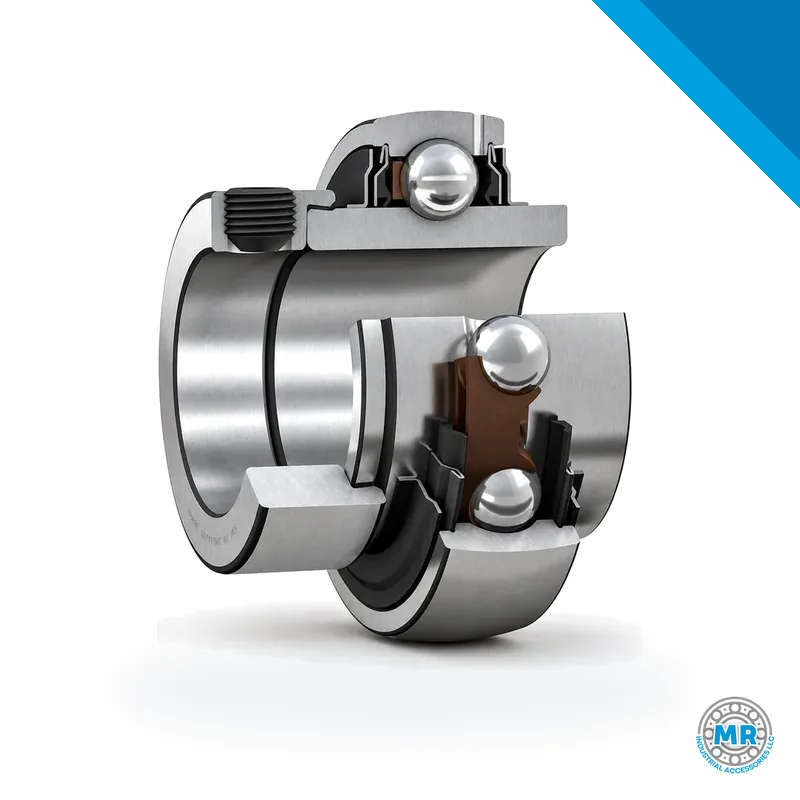

SKF YEL 211-200-2FU/VT357 y-bearing (insert bearing)
- Brand
- SKF
- Category
- Bearings
- Subcategory
- Y-bearing (insert bearing)
We reply promptly.
Tell us the quantity you need and request a quote by WhatsApp or email.
Other brands for this category
Ask us for alternatives. We check every equivalent against the part number and your application.
Can't find the exact model? Tell us the part number or model you need. We'll track it down and quote it, whether or not it appears in our catalog.
Description
SKF YEL 211-200-2FU/VT357 belongs to y-bearing (insert bearing), part of our Bearings range. Tell us how many you need by WhatsApp or email and we'll get back to you promptly with a quote for YEL 211-200-2FU/VT357 and any equivalents.
For maintenance teams working with split or pillow block housings, the SKF YEL 2FU/VT series Y-bearing is an insert that combines a spherical outer ring with a lubrication groove. It locks onto unmachined shafts using set screws, so installation is straightforward. The design tolerates minor misalignment and keeps contaminants out, making it a practical choice for many industrial drives. MR supplies this brand and can help you match the right variant to your equipment.
Reading the code helps you order correctly. YEL stands for a Y-bearing with a spherical outer ring and a lubrication groove. The 2FU part means double lip sealing with extra protection, while VT points to a cage or heat treatment variation. A full example like YEL 211-200-2FU/VT357 breaks down as series 211, shaft diameter 200 (inches), and suffix 357 for internal details. Once you know these segments, identifying a replacement becomes much simpler.
You will find these inserts in belt conveyors, bucket elevators, mixers, mills, and other process equipment across food, cement, mining, and material handling operations. They handle dusty, humid environments and moderate loads where a sealed bearing that mounts easily on drive shafts is needed. The spherical outer ring accommodates small static misalignments common in split housings, but checking overall alignment during installation still matters to avoid extra loads.
Selection depends on shaft diameter, load type (radial, axial, or combined), and operating conditions. The 2FU seal guards against dust and splashes, and the outer groove allows relubrication. When mounting, confirm housing alignment and internal clearance, apply the right grease, and tighten the set screws in a controlled way. If the shaft shows wear, a repair sleeve can be an option. Proper lubrication and tightening prevent many premature failures.
SKF Y-bearings can often be interchanged with other brands that share the same dimensional designation, such as YAR, YET, or YEL series from different manufacturers. Always check tolerances, sealing type, and load conditions before substituting. MR carries SKF and can advise on interchangeability without compromising performance. To identify the correct bearing for your machine, send the complete part number via WhatsApp or email, and the team will reply promptly with a quote and any guidance on mounting or maintenance.
Dimensions
Dimensions and tolerances: Message us the part number on WhatsApp and we'll verify its dimensions and version with the manufacturer's datasheet.
Frequently asked questions
- What does the designation YEL 2FU/VT mean?
- YEL indicates a Y-bearing with a spherical outer ring and groove; 2FU means double lip sealing; VT refers to a cage or treatment variant. The following number (e.g., 211) is the dimensional series, and any extra suffix (e.g., 357) specifies internal details. This breakdown helps you order the exact replacement.
- Is this bearing suitable for shafts with misalignment?
- Yes, the spherical outer ring allows small static misalignments typical of split housings. However, proper mounting in a suitable housing and checking overall alignment are important to avoid additional loads that could reduce service life.
- How are YEL 2FU/VT bearings lubricated?
- They have a groove and lubrication hole in the outer ring. Use high-quality grease and relubricate according to the manufacturer's interval or your working conditions. Excess grease can raise temperature, so follow the technical recommendations.