
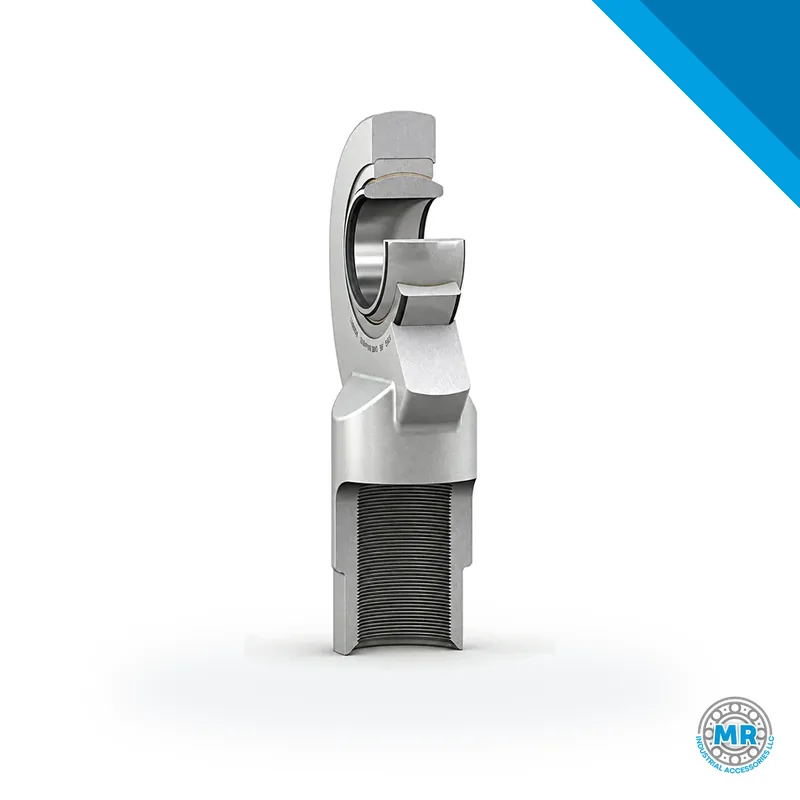

SKF SI 10 E spherical plain bearing
- Brand
- SKF
- Category
- Bearings
- Subcategory
- Spherical plain bearings and rod ends
We reply promptly.
Tell us the quantity you need and request a quote by WhatsApp or email.
Other brands for this category
Ask us for alternatives. We check every equivalent against the part number and your application.
Can't find the exact model? Tell us the part number or model you need. We'll track it down and quote it, whether or not it appears in our catalog.
Description
SKF SI 10 E belongs to spherical plain bearing, part of our Bearings range. Tell us how many you need by WhatsApp or email and we'll get back to you promptly with a quote for SI 10 E and any equivalents.
SKF SI E series rod ends are spherical bearings with a threaded male shank, built to handle oscillating motion and angular misalignment in a mechanism. They suit hydraulic and pneumatic cylinders, steering arms, suspension systems, road machinery, lifting equipment and transmission linkages where articulated movement is needed. MR Industrial Accessories supplies this line to maintenance and purchasing teams across the United States and Latin America.
Reading the code is the fastest way to narrow down a replacement. The letters SI identify a radial rod end with a male shank, while the E points to a version with its own sealing or design characteristics. The figure that follows is the nominal bore diameter in millimeters, so SI 6 E, SI 8 E, SI 10 E and SI 12 E step up in bore size. As that number grows, so do the load capacity and the outer dimensions of the unit.
For selection, start with the diameter of the shaft or pin the rod end will sit on, then look at the radial and axial loads it has to carry, the misalignment angle the mechanism needs, and the conditions around the joint. The E-type sealing is there to hold lubricant in and keep dust and moisture out. Check the critical dimensions before ordering: bore diameter, shank thread, width and tilt angle.
Rod ends in this series turn up in metalworking, automotive, agricultural and construction work, and in food and packaging lines where smooth, low-friction articulation matters. Typical mounting points include hydraulic and pneumatic cylinders, steering arms, suspension systems, road machinery, lifting equipment and transmission mechanisms that oscillate rather than rotate continuously.
During assembly, confirm the threaded shank is tightened correctly and lines up with the direction of movement in the mechanism. Periodic greasing with a suitable lubricant helps the bearing last longer, particularly where loads alternate or speeds are moderate. When a direct SKF part is not what you need, rod ends from other makers that follow the same dimensional designation, such as comparable INA, NSK or NTN series, can serve as equivalents, provided the bore, thread, width and tilt angle match.
Send the part number or the dimensions of your application by WhatsApp or email and the team will help you confirm the right rod end and suggest an equivalent where one exists.
Dimensions
Dimensions and tolerances: Message us the part number on WhatsApp and we'll verify its dimensions and version with the manufacturer's datasheet.
Frequently asked questions
- What do the letters and numbers in SI 8 E mean?
- SI tells you it is a radial rod end with a male shank, and E indicates a version with particular sealing or design features. The number, 8 in this case, is the nominal bore diameter in millimeters. Larger numbers mean a larger bore, more load capacity and bigger overall dimensions.
- How do I pick the right size for my application?
- Begin with the shaft or pin diameter that will house the rod end and match the number in the designation to it. Then check radial and axial load, the misalignment angle required, and the space available. If anything is unclear, send the dimensions and the team will advise.
- Can another brand replace an SKF SI E rod end?
- Rod ends from other manufacturers that use the same dimensional designation, such as equivalent INA, NSK or NTN series, may work as replacements. Verify the bore diameter, shank thread, width and tilt angle. Send the part number and the equivalent can be confirmed.