
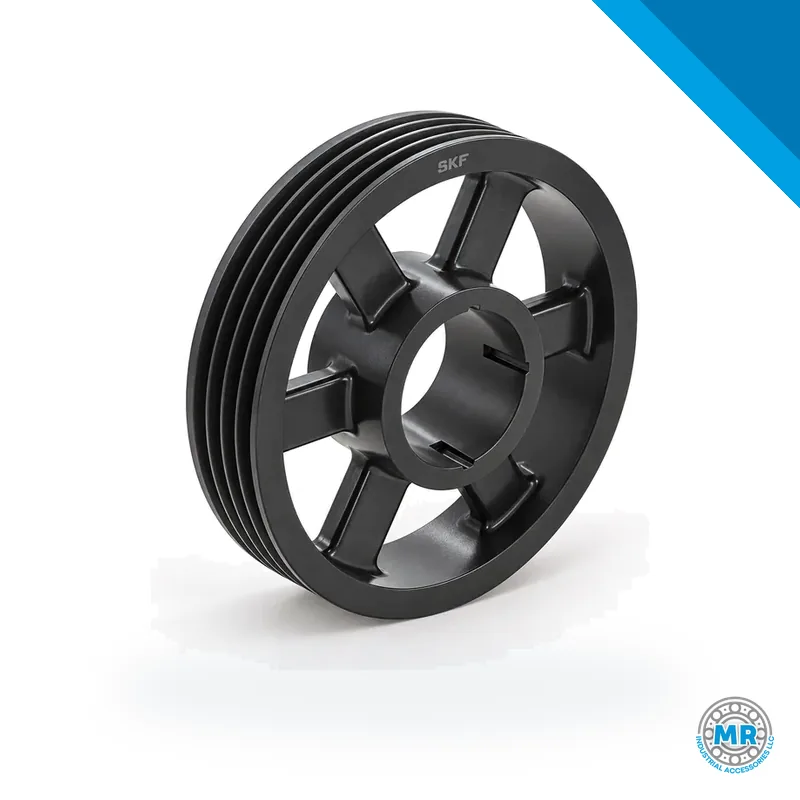

SKF PHP 10-B86-E drive pulley
- Brand
- SKF
- Category
- Power transmission
- Subcategory
- Pulleys and V-belts
We reply promptly.
Tell us the quantity you need and request a quote by WhatsApp or email.
Can't find the exact model? Tell us the part number or model you need. We'll track it down and quote it, whether or not it appears in our catalog.
Description
SKF PHP 10-B86-E belongs to drive pulley, part of our Power transmission range. Tell us how many you need by WhatsApp or email and we'll get back to you promptly with a quote for PHP 10-B86-E and any equivalents.
SKF drive pulleys transmit power between shafts in industrial machinery using V-profile belts. They appear in fans, pumps, compressors, conveyors and many other driven machines, and they are designed for straightforward maintenance. MR Industrial Accessories LLC supplies these pulleys to customers across the United States, Canada, Mexico and South America, with quote requests handled by part number through WhatsApp or email.
Reading the code makes selection easier. In a designation such as PHP 3-B380-E, the 3 stands for the number of grooves, B is the belt section, 380 mm is the pitch diameter and the -E suffix means the pulley is supplied with a taper bushing for quick mounting. Other references in the range vary in groove count and diameter following the same logic, so the code on the original part is the fastest way to identify a replacement.
These pulleys and matching V-belts are common in food processing, chemical plants, cement operations and water treatment, as well as in pumping equipment and screw compressors. The V-belt drive suits environments where dust, humidity or variable loads are present, and SKF pulleys are available in a range of sizes to cover those duties.
When selecting a pulley, confirm the power to be transmitted, the RPM of both the fast and slow shafts, and the center distance. The belt section (A, B, C, D) must match the pulley groove. During installation, check alignment with a straightedge or laser, since misalignment accelerates wear. Belt tension also matters: a belt that is too loose slips, while one that is too tight overloads the bearings. Follow the manufacturer's instructions for lubricating taper bushings and inspect sealing where dust is present.
SKF pulleys interchange with other brands made to the ISO standard for V-sections. When replacing, compare pitch diameter, number of grooves and bushing type. V-belts are standardized as well, so any belt that complies with the standard can be used. If anything is unclear, the code stamped on the original pulley or belt is the best reference.
To request a quote for SKF drive pulleys, send the exact code via WhatsApp or email. MR Industrial Accessories LLC replies promptly, can suggest equivalent parts and helps you choose the right component, whether you need a single pulley or a complete drive assembly.
Dimensions
Dimensions and tolerances: Message us the part number on WhatsApp and we'll verify its dimensions and version with the manufacturer's datasheet.
Frequently asked questions
- What does the -E at the end of an SKF pulley code indicate?
- The -E suffix means the pulley is supplied with a taper bushing. This bushing locks the pulley onto the shaft securely and simplifies mounting and removal, so a press is not required.
- How do I match a belt to my pulley?
- The belt section has to correspond to the pulley groove. Sections A, B, C and D are the common ones. The letter in the pulley code tells you which section to use; for instance, a code containing B calls for a B-section belt. If you are unsure, send us the code and we will confirm.
- When should belt tension be checked?
- Check tension shortly after the drive starts running, within the first day of operation, and then at regular intervals such as every 500 hours. Tension that is too low causes slipping, and tension that is too high puts extra load on the bearings. A tension gauge or the deflection method can be used.