
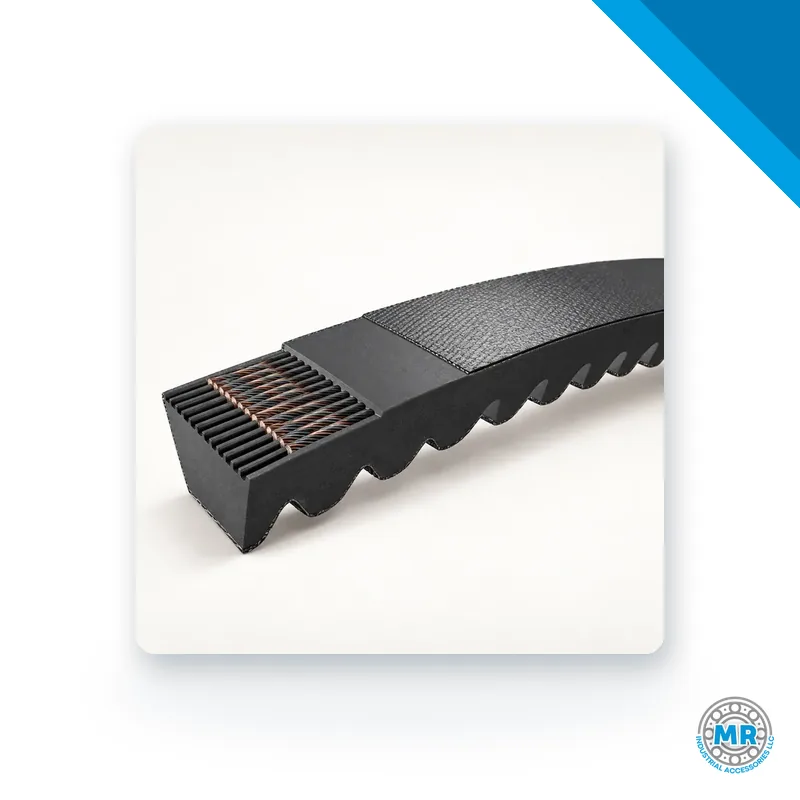

SKF PHG XPA1600EP timing belt
- Brand
- SKF
- Category
- Power transmission
- Subcategory
- Timing belts
We reply promptly.
Tell us the quantity you need and request a quote by WhatsApp or email.
Can't find the exact model? Tell us the part number or model you need. We'll track it down and quote it, whether or not it appears in our catalog.
Description
SKF PHG XPA1600EP belongs to timing belt, part of our Power transmission range. Tell us how many you need by WhatsApp or email and we'll get back to you promptly with a quote for PHG XPA1600EP and any equivalents.
SKF PHG XPA EP timing belts are synchronous drive components built around the XPA profile, a rubber body and a tensile cord. Because the teeth mesh with the pulley grooves, the belt turns the driven shaft at a fixed ratio instead of relying on friction. Maintenance and purchasing teams specify them on machines where a standard V-belt cannot hold an exact speed relationship between shafts.
Reading the code helps you order the right part. PHG is the SKF timing belt family, XPA is the narrow-section profile, and EP points to a reinforced build with a high-strength tensile cord. The digits that follow state the pitch length in millimeters, so PHG XPA757EP measures 757 mm and PHG XPA800EP measures 800 mm. The series runs from PHG XPA757EP up to PHG XPA900EP, with intermediate lengths spaced every 25 or 50 mm. Pitch, width and pulley tooth count are the three values to confirm before ordering.
Typical applications include machine tools, compressors, pumps, packaging and conveying lines, plus equipment in food and chemical plants. You will also find them on vacuum pumps, fans and mixers. Their narrow section lets the drive carry power in a tighter envelope than a classic belt, which matters when space around the pulleys is limited.
To select a belt, start with the power the drive must transmit, the speed of the fastest pulley and the center distance. The pitch length should match the belt being replaced or be worked out from the pulley tooth count. At installation, align the pulleys and set tension so the belt is neither slack nor over-tightened. Inspect the teeth for wear and the cord for damage during service. No lubrication is required, but keeping the area clean extends belt life.
Belts from other manufacturers that share the same XPA profile and pitch length can be used in place of a PHG XPA EP belt when the standardized dimensions line up. Load capacity and temperature range are not identical across every belt of the same profile, so compare the construction before substituting. When you replace a belt, check the complete code and the tooth count together.
Send the full code by WhatsApp or email to request a quote. If the code is not available, share the profile, pitch length and width, and the team will help identify the belt and suggest equivalents.
Dimensions
Dimensions and tolerances: Message us the part number on WhatsApp and we'll verify its dimensions and version with the manufacturer's datasheet.
Frequently asked questions
- What does the EP suffix mean on a PHG XPA belt?
- EP identifies a reinforced construction that uses a high-strength tensile cord. The profile and pitch length stay the same and are still set by the rest of the code.
- Can I replace an XPA belt from another brand with a SKF PHG XPA EP?
- Yes, when the XPA profile, pitch length and width are the same. Check the tooth count and load capacity too, since these can differ between manufacturers. Send us the original code and we will confirm the match.
- How do I know what belt length I need?
- The pitch length appears in the code, so PHG XPA800EP is 800 mm. If you do not have the code, measure the center distance and count the pulley teeth, and we will work out the correct belt.