
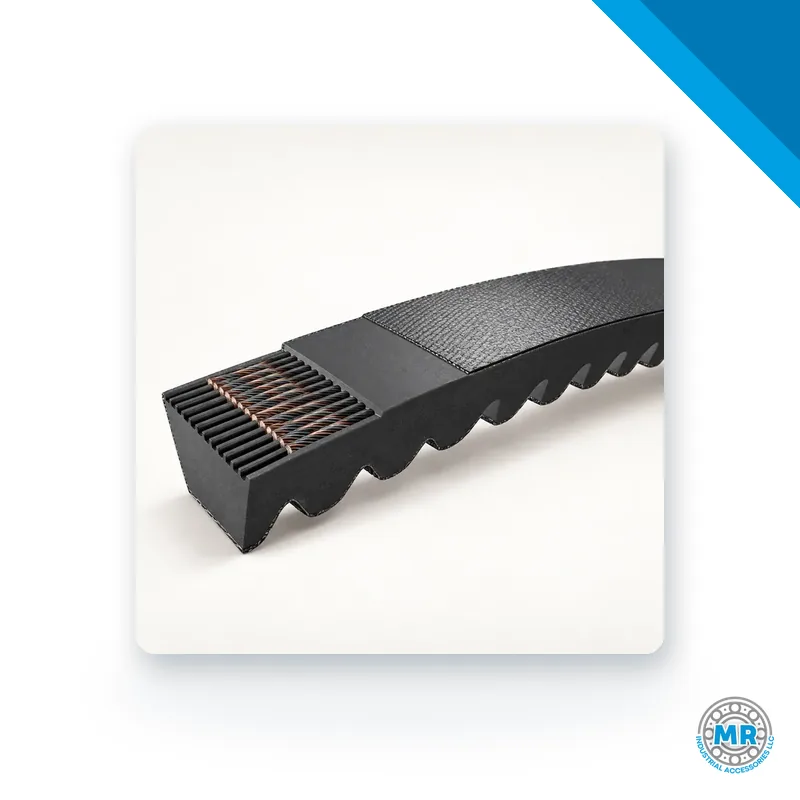

SKF PHG SPC9500XP2 timing belt
- Brand
- SKF
- Category
- Power transmission
- Subcategory
- Timing belts
We reply promptly.
Tell us the quantity you need and request a quote by WhatsApp or email.
Can't find the exact model? Tell us the part number or model you need. We'll track it down and quote it, whether or not it appears in our catalog.
Description
SKF PHG SPC9500XP2 belongs to timing belt, part of our Power transmission range. Tell us how many you need by WhatsApp or email and we'll get back to you promptly with a quote for PHG SPC9500XP2 and any equivalents.
Toothed belt drives that must hold an exact speed relationship under heavy load are where the SKF PHG SPC XP line fits. Compressors, pumps and process equipment rely on this construction to keep the ratio steady with little upkeep. MR Industrial Accessories supplies the series as part of its power transmission range for plants in the US and Latin America.
Reading the code helps you order the right belt. PHG covers the construction and profile, SPC gives the pitch and tooth form set by the standard, and the digits that follow state the pitch length in millimeters. So PHG SPC2650XP2 measures 2650 mm, while PHG SPC3550XP2 and PHG SPC9000XP2 show longer and shorter variants. The XP2 ending marks the high-performance build with a double tensile cord, which carries more power than a standard belt of equal width.
Typical duty covers food processing, cement, mining and chemical plants, wherever timing cannot drift: screw compressors, positive displacement pumps, high-flow fans and machine tools. Milling lines, water treatment works and packaging equipment are common homes for these belts, and catching wear early keeps unplanned stops out of the schedule. The SPC profile suits wide-groove pulleys running at high linear speed.
Choosing a belt means checking the power to transmit, the speed of the smaller pulley and how many teeth are actually in mesh. Alignment and tension deserve the same attention, since a loose or crooked belt wears out sooner and puts extra load on bearings. The belt itself takes no lubrication, but the supports and tensioners around it still need inspection. Confirm too that the pulley teeth match the SPC pitch before ordering.
Crossing to another maker is possible when the profile and pitch standard agree and the pitch length and width line up. A similar part number is not proof: compare the full designation and the standardized dimensions. When in doubt, send the original number along with your pulley measurements and let our team confirm the match.
To get a quote on an SKF PHG SPC XP belt, message the complete part number over WhatsApp. Without it, share the pulley data plus the length and width, and we will help pin down the item.
Dimensions
Dimensions and tolerances: Message us the part number on WhatsApp and we'll verify its dimensions and version with the manufacturer's datasheet.
Frequently asked questions
- What does the XP2 suffix mean on an SKF PHG SPC belt?
- It marks the high-performance version built with a double tensile cord. That build transmits more power than a standard belt of the same width, or lets you run a narrower belt for the same load. Keep the full part number when replacing.
- How do I know if a PHG SPC XP belt is compatible with my pulley?
- Check that the profile and pitch match the pulley; the SPC code points to the standardized pitch. The pitch length also has to suit the center distance. If anything is unclear, send us your pulley measurements.
- How often should a timing belt be replaced?
- No fixed interval applies, since conditions, tension and alignment all play a part. Inspect periodically for wear, cracks or missing teeth, and replace the belt at the first sign of deterioration to avoid a failure.