
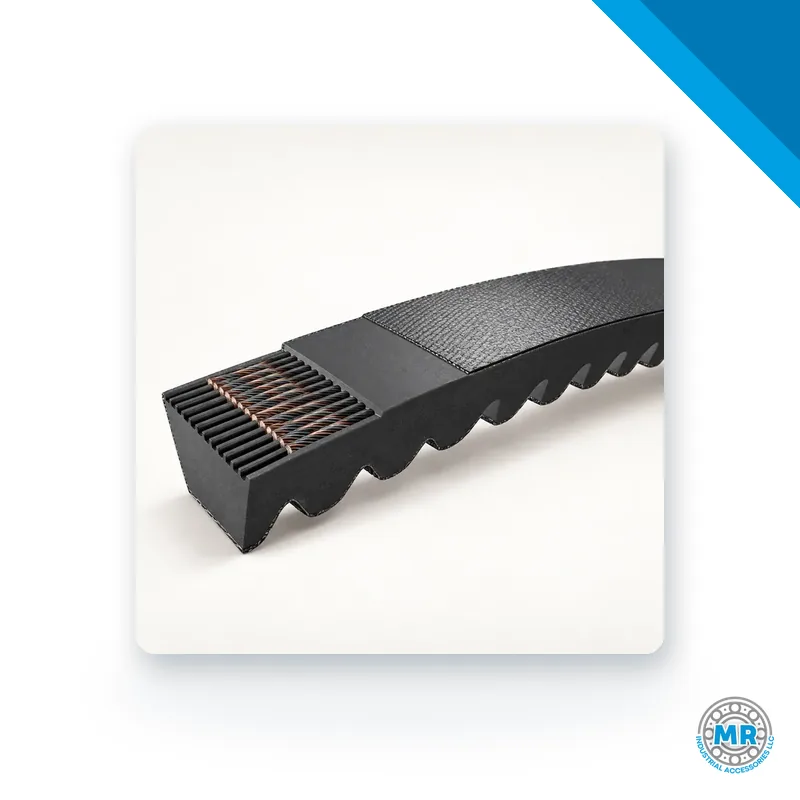

SKF PHG D-510-L-075 timing belt
- Brand
- SKF
- Category
- Power transmission
- Subcategory
- Timing belts
We reply promptly.
Tell us the quantity you need and request a quote by WhatsApp or email.
Can't find the exact model? Tell us the part number or model you need. We'll track it down and quote it, whether or not it appears in our catalog.
Description
SKF PHG D-510-L-075 belongs to timing belt, part of our Power transmission range. Tell us how many you need by WhatsApp or email and we'll get back to you promptly with a quote for PHG D-510-L-075 and any equivalents.
SKF PHG D-L timing belts are synchronous drive belts that use a toothed profile and tensile cords to transmit power without slipping. They are specified where exact speed ratios, low vibration and constant synchronization are required, such as timing mechanisms, positioners and indexing equipment. MR Industrial Accessories LLC supplies this series as part of its power transmission range for customers in the United States and several Latin American countries.
The code PHG D-…-L-… breaks down into three elements. PHG denotes the SKF timing belt family. D is the tooth profile, which defines a specific pitch and tooth geometry. The number following D gives the pitch length in tenths of an inch, and the final number gives the belt width in hundredths of an inch. For instance, a belt with 210 tenths of an inch pitch length and 050 hundredths of an inch width. Suffixes 075 and 100 indicate wider belts. Confirm both measurements before ordering.
These belts are found in food processing, textile, plastics and woodworking operations, where shafts must run in sync or parts conveyed accurately. They also appear in compressors, pumps, machine tools and packaging machinery. Production lines that need a fixed speed ratio between pulleys, without slip, often rely on them, including environments with oil or dust when sealing and cleaning are properly maintained.
Selection depends on the pulley tooth count, center distance and power to be transmitted. The D profile must match the pulley groove; otherwise, the mesh will be poor and the belt will wear prematurely. During installation, check shaft alignment and set tension according to the manufacturer's recommendation: too little tension causes tooth jumping, while too much overloads the bearings. The belt itself does not require lubrication, but the associated components do.
SKF timing belts can be interchanged with other brands that use the same profile and pitch, as line equivalents. However, designations are not universal: some manufacturers use their own nomenclature for length and width. When seeking a replacement, compare pitch, pitch length, width and tooth profile rather than the code alone. If you are unsure, send us the original measurements and we will help identify the correct option.
MR Industrial Accessories LLC supplies SKF timing belts as part of its power transmission line. To request a quote for a belt from this series, send the complete code or the pitch, length and width measurements via WhatsApp or email. Our team replies promptly and can suggest equivalents, as well as compatible pulleys and other transmission components.
Dimensions
Dimensions and tolerances: Message us the part number on WhatsApp and we'll verify its dimensions and version with the manufacturer's datasheet.
Frequently asked questions
- How do I read the size from a PHG D-L belt code?
- The code provides three pieces of information: D profile, pitch length in tenths of an inch and width in hundredths of an inch. For example, a code with 210 tenths of an inch length and 050 hundredths of an inch width. Check these values on your original belt.
- What do the 075 or 100 suffixes mean?
- The suffix indicates belt width in hundredths of an inch. 050 equals 0.50 inches, 075 equals 0.75 inches and 100 equals 1.00 inch. Wider belts handle greater power transmission, provided the pulley accepts that width.
- Can I replace an SKF belt with another brand?
- Yes, if the tooth profile, pitch, pitch length and width match. Commercial designations vary between manufacturers, so do not rely only on the code. Compare the actual measurements or ask us with the data from the original belt.