
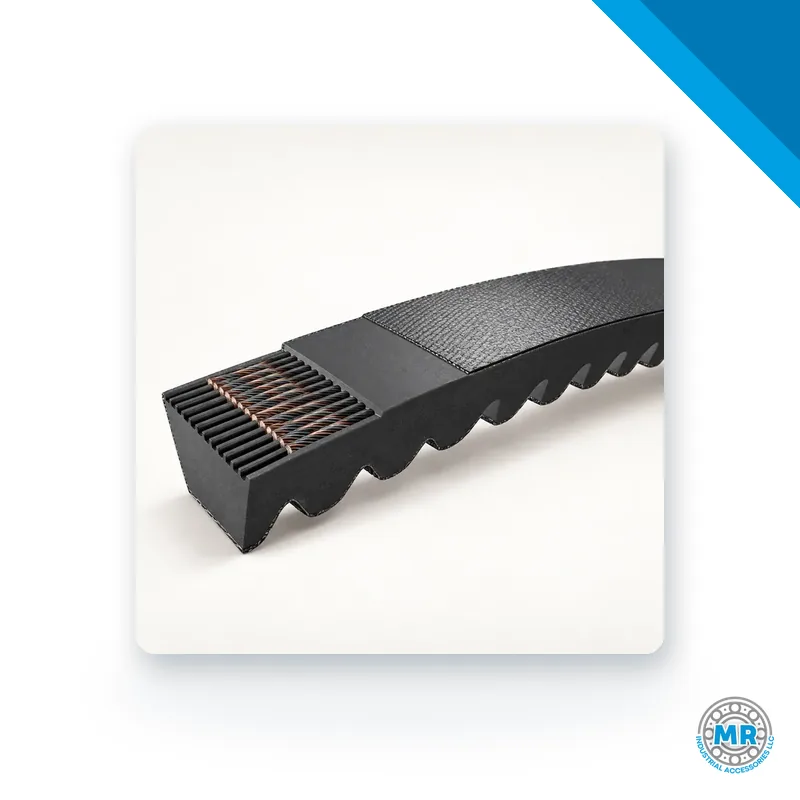

SKF PHG AT10K-1480-50 timing belt
- Brand
- SKF
- Category
- Power transmission
- Subcategory
- Timing belts
We reply promptly.
Tell us the quantity you need and request a quote by WhatsApp or email.
Can't find the exact model? Tell us the part number or model you need. We'll track it down and quote it, whether or not it appears in our catalog.
Description
SKF PHG AT10K-1480-50 belongs to timing belt, part of our Power transmission range. Tell us how many you need by WhatsApp or email and we'll get back to you promptly with a quote for PHG AT10K-1480-50 and any equivalents.
When a drive needs to stay in step, a toothed belt like the SKF PHG AT does the job. Its teeth engage the grooves of a matching pulley, so the belt and the pulley move together without slipping and the shafts stay synchronized. That makes it a common choice for automation, printing, packaging, and textile equipment. MR Industrial Accessories supplies this line as part of its power transmission range.
Reading the code helps you order the right belt. Take PHG AT10K-1480-50. PHG is the product family. AT10 is the metric toothed profile, and the 10 stands for the pitch in millimeters. The first number after the hyphen, 1480, is the pitch length in millimeters; the second, 50, is the width in millimeters. A K in the code points to a construction variant, such as the type of cord or reinforcement, depending on how the belt is built.
These belts show up wherever timing and smooth running matter. Packaging lines, printing presses, cutting and engraving machines, Cartesian robots, precision conveyors, and spindle drives are typical examples. You will also find them in food, chemical, and automotive operations. Because they hold an exact ratio and tolerate high linear speeds, they are often used to replace chains where lower noise and less maintenance are wanted.
Choosing a belt comes down to matching the pitch, length, and width your machine calls for, plus the pulley profile. Make sure the pulley is made for the AT pitch and that enough teeth are in mesh to carry the load. When you install it, keep the shafts parallel and set the tension correctly. Too tight and you wear out bearings and pulleys faster; too loose and the belt can skip teeth. These belts do not need lubrication, but keeping them clean and away from oil or extreme heat helps them last.
Belts from other makers that share the same profile and pitch, such as Optibelt, Gates, Continental, or Megadyne, can often stand in for an SKF belt, provided the dimensions and tooth shape line up. A similar length alone is not enough; the profile has to match exactly for the teeth to engage. If you are swapping out a belt from a different brand, check the full code and ask a specialist. At MR Industrial Accessories we can help you find the right equivalent.
If you already know the code you need, send it to MR Industrial Accessories by WhatsApp or email and we will get a quote back to you. If the code is not at hand, share the machine details or measure the old belt and we will help you identify the replacement. We support plants, factories, and maintenance teams across the United States and in several Latin American countries.
Dimensions
Dimensions and tolerances: Message us the part number on WhatsApp and we'll verify its dimensions and version with the manufacturer's datasheet.
Frequently asked questions
- What does the code PHG AT10K-1480-50 mean?
- PHG is the SKF timing belt line; AT10 is the 10 mm metric-pitch profile; 1480 is the pitch length in millimeters; 50 is the width in millimeters. The K denotes a construction variant. With these details you can identify the belt or search for an equivalent.
- How do I know if a belt from another brand replaces my SKF one?
- Compare the toothed profile, pitch, pitch length, and width. If all match, it is likely interchangeable. Do not rely on length alone: the AT profile must be the same. Contact us with the original code and we will help you verify.
- How often is a timing belt changed?
- There is no fixed interval; it depends on load, speed, alignment, and environment. Inspect periodically for tooth wear, cracks, or stretching. If you hear unusual noise or lose synchronization, replace it.