
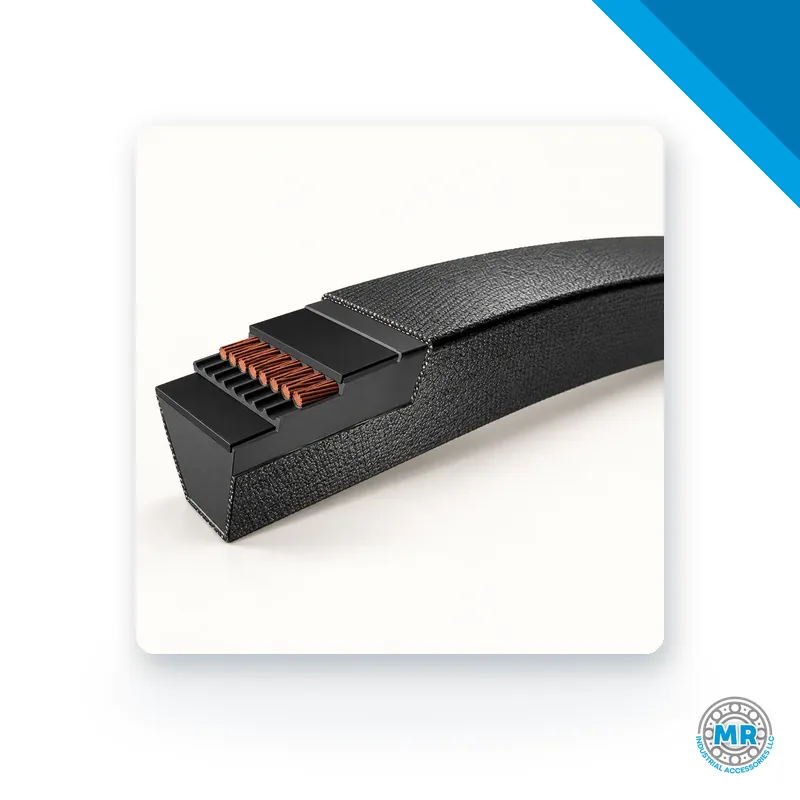

SKF PHG 5VX850EPX4 timing belt
- Brand
- SKF
- Category
- Power transmission
- Subcategory
- Timing belts
We reply promptly.
Tell us the quantity you need and request a quote by WhatsApp or email.
Can't find the exact model? Tell us the part number or model you need. We'll track it down and quote it, whether or not it appears in our catalog.
Description
SKF PHG 5VX850EPX4 belongs to timing belt, part of our Power transmission range. Tell us how many you need by WhatsApp or email and we'll get back to you promptly with a quote for PHG 5VX850EPX4 and any equivalents.
The SKF PHG EPX timing belt belongs to a line of synchronous drive belts that pair a precision tooth profile with purpose-built rubber compounds and tensile cords. It keeps shafts turning in step and moves torque across the drive without slippage, which matters wherever rotational accuracy has to hold. MR Industrial Accessories supplies this line through its power transmission program and can walk you through the selection.
The part number is built in blocks, and reading it that way saves a lot of back-and-forth. PHG marks the high-performance timing profile family. The digits that follow give the pitch length, expressed in tenths of an inch or in millimeters depending on the profile standard. Then comes the profile and pitch code, here VX, and the closing EPX tells you how the compound and the cords are made. Take PHG 5VX850EPX4: 5 is the pitch, 850 the length, EPX the execution. Sorting out those fields up front keeps a replacement order from going wrong.
Typical duty is any drive that cannot afford to slip: textile machinery, packaging lines, industrial printers, automation gear, process pumps and screw compressors. You will also see these belts on cutting and conveying equipment, where the transmission ratio has to stay steady as speeds change, and on synchronized shaft arrangements in food production, water treatment and metalworking operations.
Selection comes down to a few checks. Match the profile and pitch to the pulley, confirm the pitch length the run needs, and pick a width that fits. Inspect the pulleys for worn teeth or burrs in the grooves. Alignment matters as much as anything: angular or parallel offset wears the tooth and the cord faster. Tension should follow the equipment manufacturer's figure, since an over-tight belt loads the bearings and a loose one can jump teeth. These belts are not lubricated.
Equivalences are read from the belt itself, not from the brand on the box: profile, pitch and length are what identify it. If you still have the original number, cross those three values against the SKF PHG EPX designation. Naming conventions for compounds and cords vary between makers, so it pays to check the application before you swap anything. MR Industrial Accessories can help you decode the number and locate a matching belt in its SKF line.
Dimensions
Dimensions and tolerances: Message us the part number on WhatsApp and we'll verify its dimensions and version with the manufacturer's datasheet.
Frequently asked questions
- How do I order an SKF PHG EPX belt if I do not have the part number?
- Send a photo of the old belt by WhatsApp, along with the pulley tooth counts and the center distance. That is usually enough to work out the profile, pitch and likely length. Markings on a worn belt can also be readable in a photo, so include one if you have it.
- What does the EPX suffix mean on these belts?
- It refers to how the rubber compound and the tensile cord are built in this line. It is not a size reference. Pitch and pitch length carry the size, and those are the values to match when you replace a belt.
- Can any timing belt work as a replacement?
- Not reliably. The pitch length has to be identical and the width has to suit the pulley, even when profile and pitch line up. Compound and cord construction also affect how the belt performs in service, so confirm the three basic values first.