
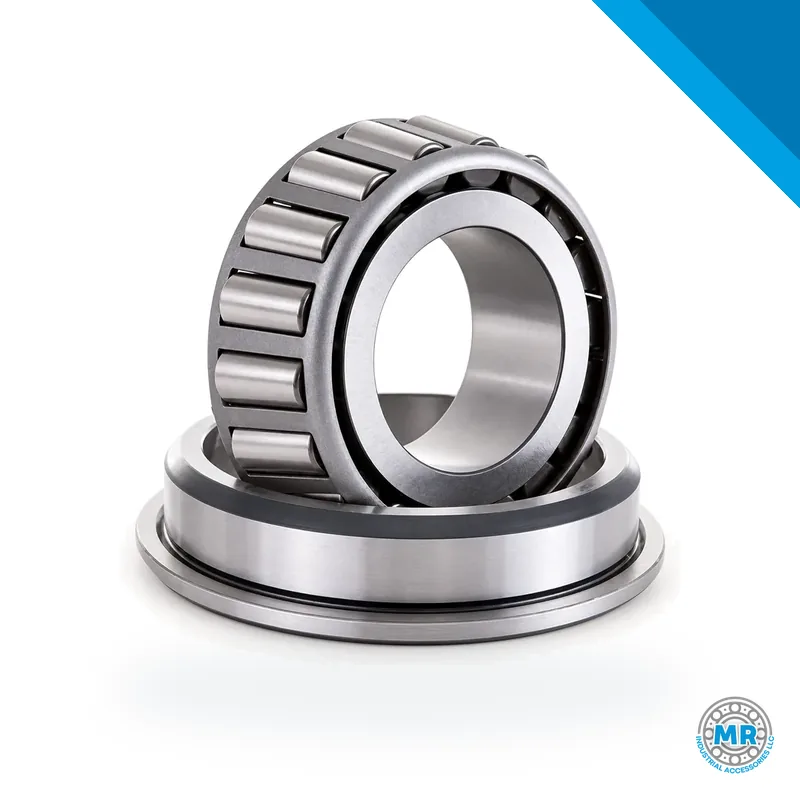

SKF PER.BT2-306037-T tapered roller bearing
- Brand
- SKF
- Category
- Bearings
- Subcategory
- Tapered roller bearings
We reply promptly.
Tell us the quantity you need and request a quote by WhatsApp or email.
Other brands for this category
Ask us for alternatives. We check every equivalent against the part number and your application.
Can't find the exact model? Tell us the part number or model you need. We'll track it down and quote it, whether or not it appears in our catalog.
Description
SKF PER.BT2-306037-T belongs to tapered roller bearing, part of our Bearings range. Tell us how many you need by WhatsApp or email and we'll get back to you promptly with a quote for PER.BT2-306037-T and any equivalents.
The SKF PER.BT2-306037-T is a single-row tapered roller bearing built for machinery that sees radial and axial force at the same time. Its tapered rolling elements run on angled raceways, so the two load directions are handled by one bearing position. This makes it a practical choice for gearboxes, conveyors, pumps and similar equipment where a cylindrical or ball bearing would not be enough.
Reading the code helps you order the correct replacement. PER tells you the bearing is a single-row tapered roller type. BT2 points to a design variant with its own dimensions and tolerances. The block 306037 is an internal reference that fixes the size and internal geometry of the assembly. Finally, the -T suffix marks a special heat treatment applied for dimensional stability. Once you know how the designation is built, matching it to the old bearing is straightforward.
Typical service is in food processing, cement, mining and automotive plants, as well as in agricultural equipment such as seeders and harvesters. Conveyors, mills, pumps, reducers and road machinery all rely on this bearing family, especially outdoors where dust, vibration and changing loads are part of daily operation.
Selection comes down to the radial and axial loads the position must carry, the running speed and the space available. During mounting, alignment has to be accurate and internal clearance set correctly by moving the cups axially. Grease or oil both work as lubricants, depending on speed and temperature. Good sealing keeps contaminants out and helps the bearing reach its expected service life, so follow the manufacturer's mounting and startup instructions.
Bearings from other makers, including Timken, NSK, FAG and NTN, can sometimes serve as replacements. Interchangeability depends on bore, outer diameter and width matching, plus a compatible contact angle. A similar-looking part number is not proof of equivalence, since tolerances and internal design differ between makers. Comparing real measurements and the actual service conditions is the safer route, and we can assist with that comparison.
For a quote, send the full part number by WhatsApp or email. If you do not have it, share the measurements or a photo of the component and we will help identify it. Our team can also suggest equivalents and guide you toward the right choice for your application.
Dimensions
Dimensions and tolerances: Message us the part number on WhatsApp and we'll verify its dimensions and version with the manufacturer's datasheet.
Frequently asked questions
- What does the -T suffix indicate on PER.BT2-306037-T?
- It shows that the bearing received a special heat treatment for dimensional stability, which lets it run at higher temperatures while holding its precision. When replacing it, keep this feature in mind: a bearing without the treatment may distort and fail early.
- How can I check whether a bearing from another brand replaces SKF PER.BT2-306037-T?
- Compare bore, outer diameter, width and contact angle. Part numbers alone are not reliable, since each maker has its own coding system. If anything is unclear, send us the measurements and the application and we will help you find a suitable option.
- Which lubricant suits these bearings?
- It depends on speed, temperature and the surrounding environment. At moderate speeds and normal temperatures, a lithium grease with EP additives is often enough, while tougher applications call for oil. Follow the manufacturer's guidance and confirm the lubricant works with the seals.