
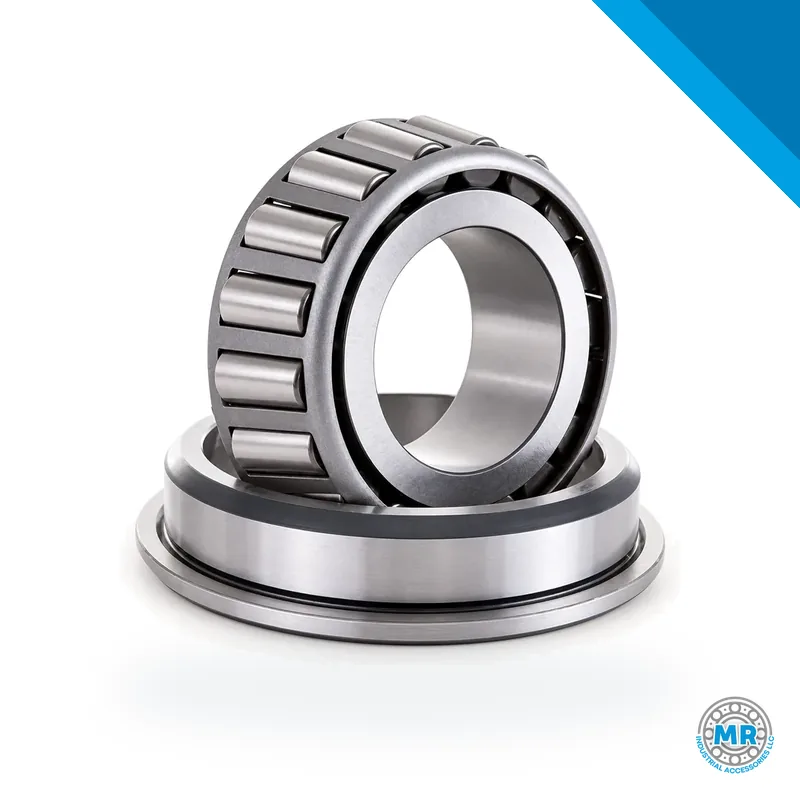

SKF PER.32018X tapered roller bearing
- Brand
- SKF
- Category
- Bearings
- Subcategory
- Tapered roller bearings
We reply promptly.
Tell us the quantity you need and request a quote by WhatsApp or email.
Other brands for this category
Ask us for alternatives. We check every equivalent against the part number and your application.
Can't find the exact model? Tell us the part number or model you need. We'll track it down and quote it, whether or not it appears in our catalog.
Description
SKF PER.32018X belongs to tapered roller bearing, part of our Bearings range. Tell us how many you need by WhatsApp or email and we'll get back to you promptly with a quote for PER.32018X and any equivalents.
SKF tapered roller bearings handle radial and axial loads at the same time. The cone geometry produces linear contact that spreads the load, which suits equipment where combined forces and some misalignment are present. MR Industrial Accessories supplies this line and helps you match the right part number to your application.
The series code starts with PER. and continues with a four- or five-digit number plus the suffix X. In PER.32018X, the digits identify a bearing built to the ISO dimension plan for series 32018, while the X marks a design variant, often tied to the contact angle or the edge geometry. It is not an internal MR number. When you request a quote, send the full code exactly as it appears on the drawing or the equipment nameplate.
You will find these bearings in food processing, cement, mining, oil and aggregate plants. They are common in gear reducers, conveyors, mills, mixers, high-flow centrifugal pumps and road equipment. In agriculture, seeders and harvesters rely on them because combined loads and dusty conditions call for a robust bearing with good sealing. Since they take axial load in one direction, tandem or opposed mounting arrangements work well.
Selection depends on the radial and axial load the equipment carries, the rotation speed and the lubrication method. Mounting calls for precise alignment between the cone and the cup; too much misalignment shortens service life. Check the axial clearance the equipment manufacturer specifies and set it with shims or nuts as needed. In dusty or damp areas, choose variants with integrated seals. Grease or oil both work; for high-speed operation, oil with forced circulation is the better choice.
Tapered roller bearings are made to international standards, so part numbers can often be interchanged between brands when dimensions and contact angle match. Suffixes are another matter: an X may not mean the same thing from one maker to the next. Before replacing a bearing, compare bore, outer diameter and width, then check with our team. We can point you to the right option among the brands we supply.
If you already have the bearing part number, send it by WhatsApp along with a photo of the nameplate or drawing. Our team verifies the designation and replies with the quote. We also work with other bearing and power transmission lines.
Dimensions
Dimensions and tolerances: Message us the part number on WhatsApp and we'll verify its dimensions and version with the manufacturer's datasheet.
Frequently asked questions
- What does the X suffix mean on a tapered roller bearing?
- The X suffix typically marks a design variant, such as a changed contact angle or special edge treatment. It is not a universal code, and each manufacturer may use it differently. Send the complete code and, if possible, the main dimensions when you request a quote.
- How can I tell if an SKF tapered roller bearing interchanges with another brand?
- Interchangeability comes down to matching bore, outer diameter, width and contact angle. ISO standards make this easier, but suffixes can differ between brands. Share the original code with us and we will help you confirm compatibility before you replace the bearing.
- What lubrication should I use on tapered roller bearings in a dusty environment?
- For dusty conditions, use a high-viscosity grease with anti-wear properties, and consider bearings with integrated seals to keep contamination out. How often you relubricate depends on speed and operating temperature. For severe applications, ask our technical team.