
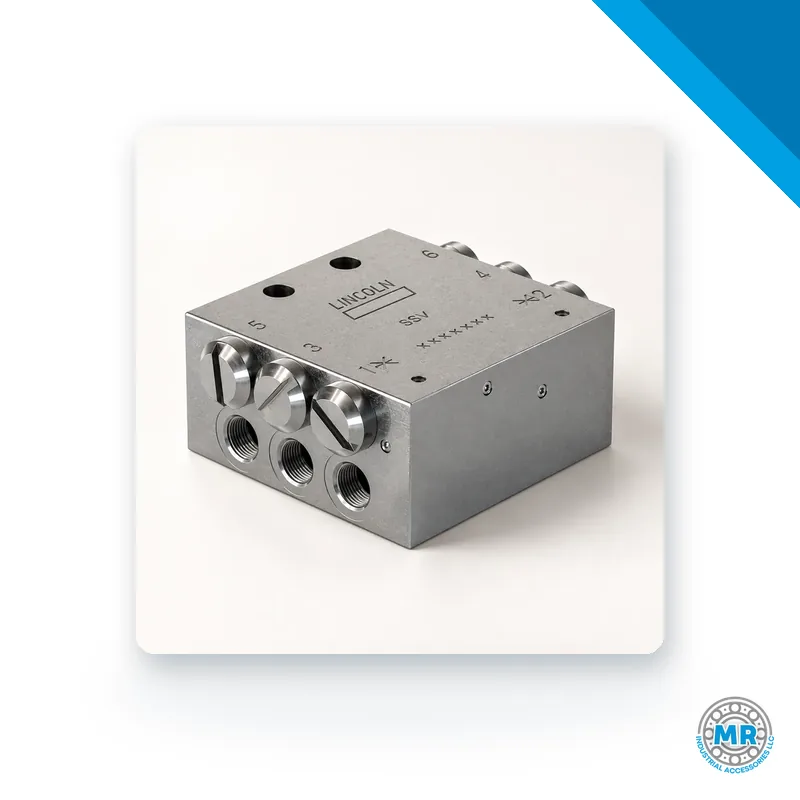

SKF LL/CU-104-F5 centralized lubrication component
- Brand
- SKF
- Category
- Greases and lubrication
- Subcategory
- Centralized lubrication systems
We reply promptly.
Tell us the quantity you need and request a quote by WhatsApp or email.
Can't find the exact model? Tell us the part number or model you need. We'll track it down and quote it, whether or not it appears in our catalog.
Description
SKF LL/CU-104-F5 belongs to centralized lubrication component, part of our Greases and lubrication range. Tell us how many you need by WhatsApp or email and we'll get back to you promptly with a quote for LL/CU-104-F5 and any equivalents.
When a machine depends on automatic lubrication, each pump, metering device, fitting, hose, and connector plays a critical role. This SKF Lincoln centralized lubrication component keeps grease or oil flowing to every point without manual effort, which matters in equipment where missed lubrication leads to downtime. MR Industrial Accessories LLC supplies these parts to maintenance teams across the United States and Latin America. To get a quote, just send the part number via WhatsApp or email.
Lincoln part numbers follow a structured format. Take LL/CU-104-F5 as an example: the leading letters indicate the component family or line, the middle numbers specify the size or variant, and the F5 suffix identifies a particular configuration such as connection type, material, or mounting style. Because each code maps to one exact combination, always order using the full part number from your drawing or bill of materials.
You will find these components in production lines, presses, conveyors, mills, mining and aggregate equipment, and agricultural machinery. Food processing and packaging plants also rely on them, since automatic lubrication cuts down on manual intervention. In facilities that run long shifts and have hard-to-reach lubrication points, centralized systems are often the only practical solution.
Selecting the right part means matching the system's working pressure, the flow required at each lubrication point, and the grease or oil being used. During installation, keep connections clean—a single particle can clog a metering device or fitting and starve downstream points. Before startup, verify joint torque, check for leaks, and bleed any trapped air from the lines.
Unlike bearings, centralized lubrication parts are replaced by part number rather than by standardized dimensions. Interchangeability between brands is possible when thread, flow rate, working pressure, and drive type align, but appearance alone is not a reliable guide. If the original code is missing, send a photo of the part along with equipment details, and we can help identify the correct replacement.
Whether you need a pump, metering device, fitting, hose, or connector for an SKF Lincoln system, message us on WhatsApp with the complete part number and quantity. MR Industrial Accessories LLC quotes centralized lubrication components as well as bearings, power transmission parts, seals, and mounting tools. With the code in hand, we can respond quickly and suggest equivalents if needed.
Dimensions
Dimensions and tolerances: Message us the part number on WhatsApp and we'll verify its dimensions and version with the manufacturer's datasheet.
Frequently asked questions
- How do I order the correct spare part for my centralized lubrication system?
- Provide the complete part number from the equipment or manual. If you don't have it, send a photo of the part, the pump or metering device model, and the system brand. We'll identify the component and quote you on WhatsApp.
- Can SKF Lincoln components be replaced by those of another brand?
- Sometimes, but similarity in appearance isn't enough. You need to compare thread, flow rate, working pressure, and drive type. If those match, it may work; if not, the system can become unbalanced. Contact us with the code and we'll review the alternative.
- What care does a centralized lubrication system need?
- Keep the reservoir clean and use the recommended grease or oil. Periodically check for leaks, confirm metering devices are delivering, and ensure lines aren't blocked. A loose or dirty connection is the most common cause of a lubrication point being starved.