
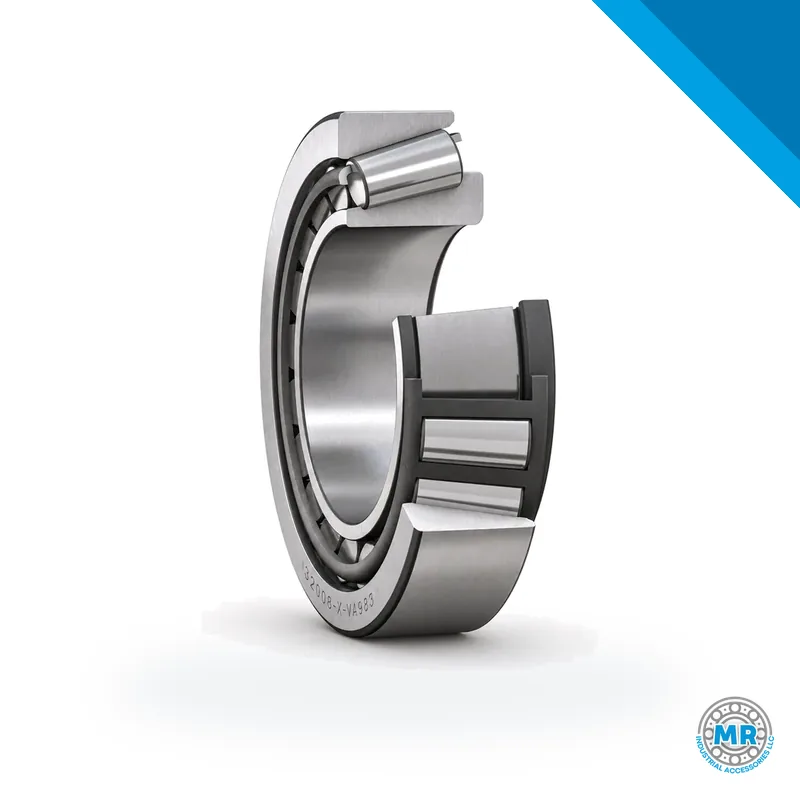

SKF JM 511946/910 tapered roller bearing
- Brand
- SKF
- Category
- Bearings
- Subcategory
- Tapered roller bearings
We reply promptly.
Tell us the quantity you need and request a quote by WhatsApp or email.
Other brands for this category
Ask us for alternatives. We check every equivalent against the part number and your application.
Can't find the exact model? Tell us the part number or model you need. We'll track it down and quote it, whether or not it appears in our catalog.
Description
SKF JM 511946/910 belongs to tapered roller bearing, part of our Bearings range. Tell us how many you need by WhatsApp or email and we'll get back to you promptly with a quote for JM 511946/910 and any equivalents.
Tapered roller bearings in the SKF JM series are built for machinery that pushes a shaft in one direction while it turns. The tapered raceways and cone-shaped rollers make line contact with the races, so the assembly accepts radial and axial force at the same time. Typical homes for these bearings are gearboxes, transmission shafts and other industrial drives where rigidity matters. MR Industrial Accessories supplies this line within its SKF bearing range.
Reading the code helps you order the right piece. The J points to a design whose dimensions and contact angle follow a standard, while the M signals a change to the cage or to machining. A code such as JM 205149/110, JM 511946/910 or JM 738249/210 pairs a cone number with a cup number, separated by a slash. Both numbers together describe the full assembly, so the safest way to order a replacement is to send the complete code or both halves as they appear on the drawing.
You will find these bearings in food processing, petrochemical plants, mining and metalworking shops. Speed reducers, machine tools, process pumps, conveying lines and gear transmission systems are common applications, along with rolling mill rolls and milling spindles. Because they take thrust in a single direction, they suit inclined shafts or shafts that push one way, and they are normally installed in opposing pairs so both directions are covered.
Choosing a size comes down to the radial and axial load involved, the running speed and the lubrication method. Fitting calls for an interference fit on the inner ring and a controlled axial clearance, set with lock nuts or shims. Shaft and housing must line up well, since misalignment cuts service life. Open versions work in clean areas, while radial shaft seals or extra protection are worth considering where dust or moisture is present.
Interchange is possible across brands when the cone and cup dimensions and the contact angle line up, since tapered roller bearings follow international standards. SKF, Timken, FAG, NSK and NTN publish cross references, but the code alone is not enough: check dimensions and load capacity. If you are swapping out another brand, send the original data and we will help you match it to the SKF equivalent.
Have the complete code ready before you ask for a quote, plus cone and cup dimensions if you have them and a note on the application. With that, the team can point you to the right variant in the JM series. Send the code by WhatsApp or email and you will get a prompt reply.
Dimensions
Dimensions and tolerances: Message us the part number on WhatsApp and we'll verify its dimensions and version with the manufacturer's datasheet.
Frequently asked questions
- What does the JM designation mean on an SKF tapered roller bearing?
- The J refers to a design whose dimensions and angle follow a standard, and the M usually marks a change to the cage or machining. The numbers after it, split by a slash, identify the cone and the cup. Order by the complete code.
- How is an SKF JM series tapered roller bearing mounted?
- The inner ring takes an interference fit, and axial clearance is set with lock nuts or shims. Shaft and housing alignment has to be accurate. These bearings are generally arranged in opposing pairs so axial loads are covered in both directions.
- Can I replace a bearing from another brand with an SKF JM series bearing?
- Yes, when the cone and cup dimensions and the contact angle match. International standards allow interchangeability, but confirm dimensions and load capacity first. Send us the original code and we will help you find the SKF equivalent.