
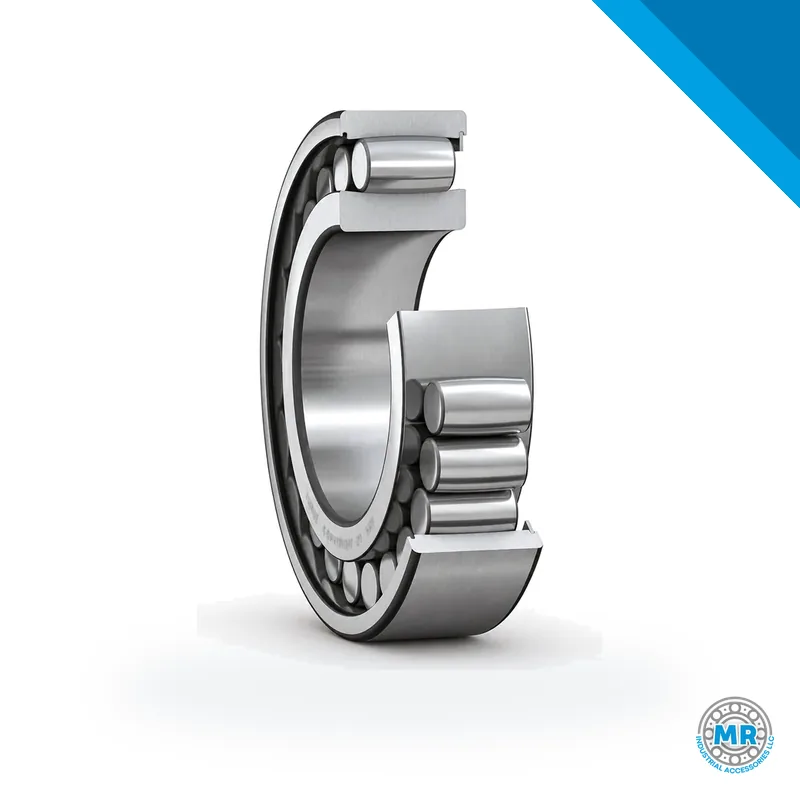

SKF C 3080 KM cARB roller bearing
- Brand
- SKF
- Category
- Bearings
- Subcategory
- CARB roller bearings
We reply promptly.
Tell us the quantity you need and request a quote by WhatsApp or email.
Other brands for this category
Ask us for alternatives. We check every equivalent against the part number and your application.
Can't find the exact model? Tell us the part number or model you need. We'll track it down and quote it, whether or not it appears in our catalog.
Decoding SKF C 3080 KM
- C 30Series
- CARB roller bearings, C 30 series. Series differ in outside diameter and width even when the bore is the same.
- 80Bore
- Bore 400 mm (80 × 5).
- KMSuffix
- SKF suffix: identifies the variant, such as seals or shields, cage, internal clearance or other features.
C 3080 is the standard ISO basic designation, which sets the bearing type, series and bore.
Description
SKF C 3080 KM measures 400 mm across the bore and 600 mm across the outside diameter; its width is 148 mm (400 x 600 x 148 mm).
SKF C 3080 KM belongs to cARB roller bearing, part of our Bearings range. Tell us how many you need by WhatsApp or email and we'll get back to you promptly with a quote for C 3080 KM and any equivalents.
The SKF CARB C KM series is a single row toroidal roller bearing built for high radial loads and angular misalignment between shaft and housing. Its self-aligning, space-saving design suits setups where shaft deflection or mounting errors are present. We supply this series as part of our SKF bearing range.
Reading the code helps with selection: the C stands for the single row CARB series, the following number (for example, C 3080 KM) sets size and load capacity, and the KM suffix means a tapered bore with a mounting sleeve for an interference fit. That arrangement simplifies mounting and fine adjustment on cylindrical shafts.
Typical industries include cement, mining, steel, paper and material handling. You will find these bearings in belt conveyors, mills, crushers, industrial fans and paper machines, where loads are high and alignment varies. Their self-aligning behavior reduces wear and extends the service life of the assembly.
When selecting a CARB C KM bearing, consider radial load, rotational speed and the permissible degree of misalignment. Mounting with a tapered sleeve calls for thorough cleaning and controlled adjustment; check internal clearance after tightening the sleeve. Use lubrication suited to the operating temperature and speed, and confirm correct initial alignment to benefit from the self-aligning capability.
Equivalent designs from other brands may be interchangeable, but always verify dimensions, tolerances and load capacity before replacing. Not all toroidal rollers share the same characteristics, so consult our team to validate compatibility for each application.
To request a quote, send the part number or dimensions via WhatsApp or email. Our team replies promptly and can suggest equivalents and help you choose the right bearing.
Dimensions
400 x 600 x 148 mm (d x D x B): boundary dimensions for basic designation C 3080, according to ISO 15.
- Bore
- 400mm
- Outside diameter (D)
- 600mm
- Width (B)
- 148mm
Frequently asked questions
- SKF C 3080 KM bearing: what are its dimensions?
- SKF C 3080 KM measures 400 mm across the bore and 600 mm across the outside diameter; its width is 148 mm (400 x 600 x 148 mm). Those are the boundary dimensions standardized in ISO 15 for basic designation C 3080.
- What does the KM suffix mean on a CARB bearing?
- The KM suffix indicates a tapered bore supplied with a mounting sleeve. This allows an interference fit on cylindrical shafts, which simplifies mounting and dismounting in industrial applications.
- When should I choose a CARB bearing over a deep groove ball bearing?
- Choose CARB when angular misalignment exists between shaft and housing, or when radial loads are high and self-alignment is needed. Deep groove ball bearings do not tolerate significant misalignment and may fail prematurely under those conditions.
- How is a CARB bearing with a tapered sleeve mounted?
- Clean the shaft and sleeve, place the bearing and tighten the lock nut with a suitable wrench. Check internal clearance after adjustment and lubricate correctly. Follow the manufacturer's instructions and verify alignment.