
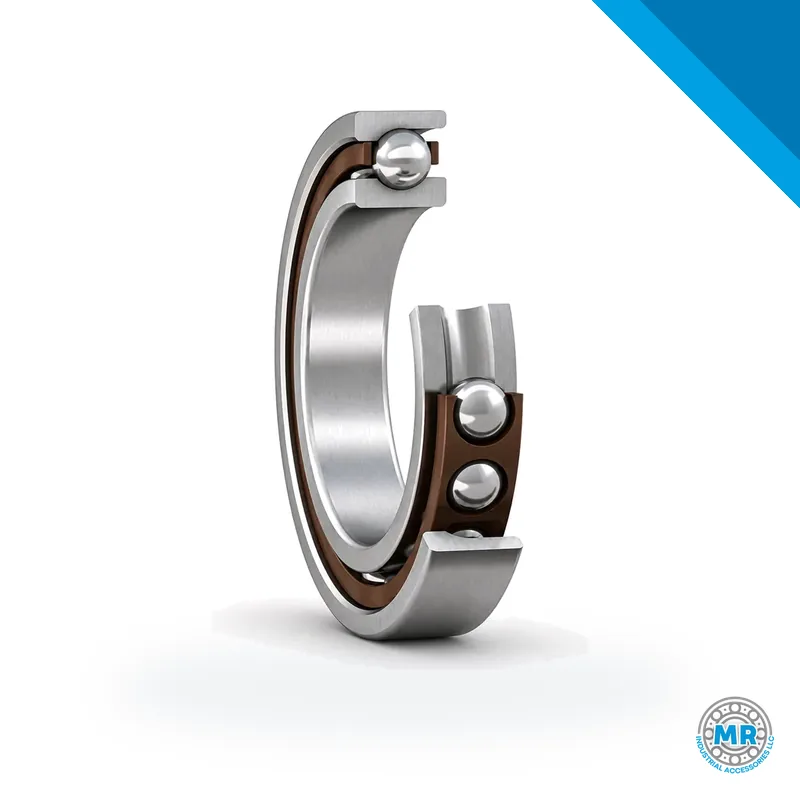

SKF 7028 BGM angular contact ball bearing
- Brand
- SKF
- Category
- Bearings
- Subcategory
- Angular contact ball bearings
We reply promptly.
Tell us the quantity you need and request a quote by WhatsApp or email.
Other brands for this category
Ask us for alternatives. We check every equivalent against the part number and your application.
Can't find the exact model? Tell us the part number or model you need. We'll track it down and quote it, whether or not it appears in our catalog.
Decoding SKF 7028 BGM
- 70Series
- Angular contact ball bearings, 70 series. Series differ in outside diameter and width even when the bore is the same.
- 28Bore
- Bore 140 mm (28 × 5).
- BGMSuffix
- SKF suffix: identifies the variant, such as seals or shields, cage, internal clearance or other features.
7028 is the standard ISO basic designation, which sets the bearing type, series and bore.
Description
SKF 7028 BGM belongs to angular contact ball bearing, part of our Bearings range. Tell us how many you need by WhatsApp or email and we'll get back to you promptly with a quote for 7028 BGM and any equivalents.
SKF BGM series angular contact bearings are built to handle combined radial and axial loads in a single direction. They suit applications that call for precision and rigidity, such as machine tool spindles, pumps and gearboxes. These bearings are part of the SKF line we supply to customers across the United States and Latin America. Our team can help you confirm the right model for your equipment.
Reading the designation helps you select the correct bearing. The numeric prefix identifies the series and size, while the BGM suffix covers design details such as the contact angle and cage type. In part numbers like 7028 BGM, 7409 BGM and 7411 BGM, the number sets the size and the suffix tells you about the internal configuration. Understanding this code makes it easier to match a bearing to your application.
Typical uses include centrifugal pumps, compressors, milling machine and lathe spindles, and gearboxes in metalworking, food processing and petrochemical operations. Because these bearings take axial loads in one direction, they are often mounted in pairs so the arrangement absorbs forces in both directions.
When selecting a bearing, consider the load type, rotation speed and operating environment. Sealing matters for keeping lubricant in and contaminants out; in dirty conditions, sealed or shielded versions are the better choice. Internal clearance and preload should be set to suit the application so rigidity and precision are maintained. Correct lubrication, grease or oil, supports service life, and precise alignment during mounting helps prevent extra loads and early failures.
For interchangeability, SKF angular contact bearings can be replaced by other brands that follow the same standardized dimensions and similar designations. Check tolerances and contact angle, since these can differ between manufacturers. Review the technical specifications before substituting a bearing to confirm compatibility and performance in your equipment.
To request a quote for SKF BGM series angular contact bearings, send the complete part number through WhatsApp or email. We will help you find the exact size your application needs and reply promptly.
Dimensions
- Bore
- 140mm
Frequently asked questions
- What does the BGM suffix mean on an SKF bearing?
- The BGM suffix identifies design characteristics such as the contact angle and cage type. These details affect load capacity and permissible speed. If you need help interpreting a code, contact us via WhatsApp.
- How do I choose between an angular contact bearing and a radial one?
- Angular contact bearings support combined radial and axial loads in one direction, while radial bearings handle radial loads only. If your application involves significant axial forces, an angular contact bearing is the appropriate choice. Also consider the required speed and precision.
- Are SKF BGM bearings interchangeable with other brands?
- They can be interchangeable with bearings from other brands that meet the same standardized dimensions and have equivalent designations. Verify tolerances and contact angle, as these may differ. If unsure, send us the original code and we will advise you.