
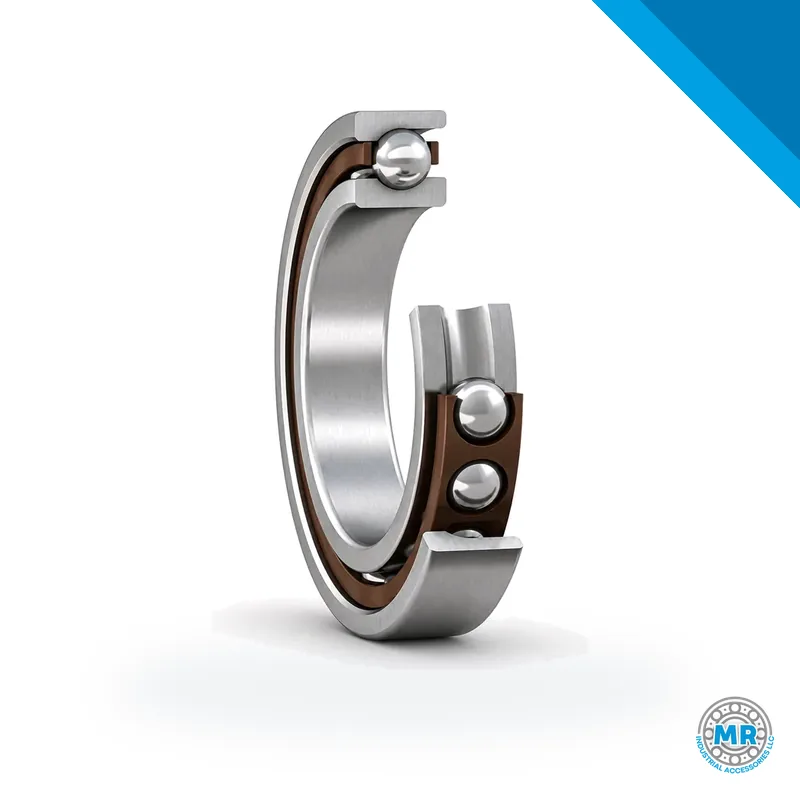

SKF 7024 ACEGA/P4A angular contact ball bearing
- Brand
- SKF
- Category
- Bearings
- Subcategory
- Angular contact ball bearings
We reply promptly.
Tell us the quantity you need and request a quote by WhatsApp or email.
Other brands for this category
Ask us for alternatives. We check every equivalent against the part number and your application.
Can't find the exact model? Tell us the part number or model you need. We'll track it down and quote it, whether or not it appears in our catalog.
Decoding SKF 7024 ACEGA/P4A
- 70Series
- Angular contact ball bearings, 70 series. Series differ in outside diameter and width even when the bore is the same.
- 24Bore
- Bore 120 mm (24 × 5).
- ACEGA/P4ASuffix
- SKF suffix: identifies the variant, such as seals or shields, cage, internal clearance or other features.
7024 is the standard ISO basic designation, which sets the bearing type, series and bore.
Description
SKF 7024 ACEGA/P4A belongs to angular contact ball bearing, part of our Bearings range. Tell us how many you need by WhatsApp or email and we'll get back to you promptly with a quote for 7024 ACEGA/P4A and any equivalents.
SKF angular contact bearings handle radial and axial loads acting in one direction. The contact angle design delivers the rigidity and accuracy needed for high-speed, precision equipment. MR Industrial Accessories supplies this line to maintenance and purchasing teams across the United States and Latin America. Share the complete part number and we will help you confirm the right bearing for your application.
The code breaks down into meaningful blocks. In 7024 ACEGA/P4A, ACE identifies the angular contact design with a 25° contact angle and a polyamide cage. The G confirms the cage material is polyamide with fiberglass reinforcement. The trailing A denotes an internal variant. P4A sets the dimensional and running precision class, holding tighter tolerances than the normal class. Reading these suffixes correctly tells you what the bearing can do before you install it.
Typical installations include machine tool spindles, high-speed electric motors, pumps, compressors, and power transmission equipment. Metalworking, automotive, and food processing plants rely on them where accuracy and repeatability matter. They also appear in gear reducers and gearboxes that see notable axial loads. High-speed capability makes them a fit for machining and grinding operations.
Selection starts with the direction of the axial load and the mounting arrangement. Because these bearings accept axial load in one direction only, they are usually installed in pairs, either face-to-face or matched. Lubrication and sealing choices follow speed and operating temperature. Shaft and housing alignment must be precise to prevent extra stress. Internal clearance also affects running behavior, so verify tolerances when the application is demanding.
Interchange between brands is possible when bore, series, contact angle, and precision class align. Suffix systems differ from one manufacturer to another, but the basic designation usually remains compatible. Check cage type and tolerances before substituting. Our team can review interchangeability so your equipment keeps running as intended.
For a quote or a replacement, send the full code by WhatsApp or email. MR Industrial Accessories helps you match the component to the application. We reply promptly and can suggest equivalents when needed.
Dimensions
- Bore
- 120mm
Frequently asked questions
- What does the P4A suffix mean in the designation?
- P4A indicates the precision class, with tighter dimensional and running tolerances than the normal class. This suits applications that demand high accuracy, such as machine tool spindles.
- Can I replace a bearing from this series with one from a different brand?
- Yes, provided the main dimensions, contact angle, and precision class match. Suffixes vary between manufacturers, so verify the technical specifications before replacement.
- How are these bearings lubricated?
- Grease or oil can be used, depending on speed and working temperature. Oil is common for high speeds, while grease suits slower applications. Follow the equipment manufacturer's instructions.