
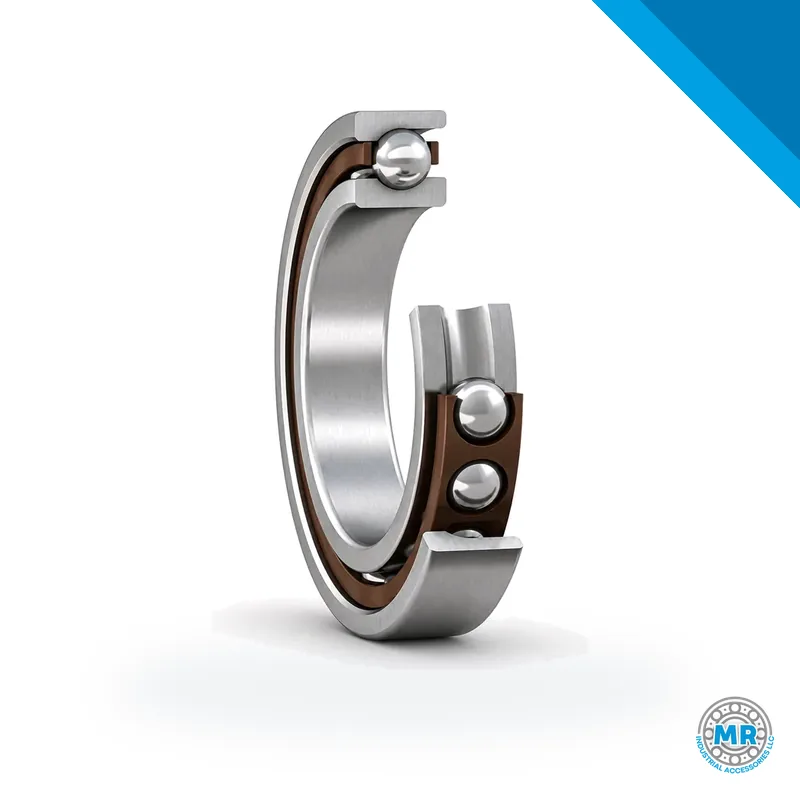

SKF 7014 ACD/HCP4ATBTA angular contact ball bearing
- Brand
- SKF
- Category
- Bearings
- Subcategory
- Angular contact ball bearings
We reply promptly.
Tell us the quantity you need and request a quote by WhatsApp or email.
Other brands for this category
Ask us for alternatives. We check every equivalent against the part number and your application.
Can't find the exact model? Tell us the part number or model you need. We'll track it down and quote it, whether or not it appears in our catalog.
Decoding SKF 7014 ACD/HCP4ATBTA
- 70Series
- Angular contact ball bearings, 70 series. Series differ in outside diameter and width even when the bore is the same.
- 14Bore
- Bore 70 mm (14 × 5).
- ACD/HCP4ATBTASuffix
- SKF suffix: identifies the variant, such as seals or shields, cage, internal clearance or other features.
7014 is the standard ISO basic designation, which sets the bearing type, series and bore.
Description
SKF 7014 ACD/HCP4ATBTA belongs to angular contact ball bearing, part of our Bearings range. Tell us how many you need by WhatsApp or email and we'll get back to you promptly with a quote for 7014 ACD/HCP4ATBTA and any equivalents.
For machine tool spindles and other precision drives that handle combined radial and axial loads in one direction, SKF angular contact bearings deliver the speed and rigidity required. This example, 7014 ACD/HCP4ATBTA, is a pre-adjusted, universally matchable set built for high-speed operation. MR Industrial Accessories supplies these bearings to maintenance and purchasing teams across the United States and Latin America, and our team can help you confirm the right designation for your application.
The part number breaks down into distinct blocks. The 7014 indicates the size. ACD refers to a 25° contact angle and a high-performance polyamide cage. HCP means ceramic balls with a polyamide cage. ATBTA identifies a pre-adjusted, universally matchable set that can be mounted in tandem or back-to-back. Reading the full code helps you avoid mismatches when replacing a bearing.
These bearings are common in milling, grinding and machining center spindles, as well as high-frequency electric motors, turbochargers, vacuum pumps and measuring equipment. Their ability to take combined loads makes them suitable for precision drives where running accuracy and repeatability affect the final result.
Selection depends on the direction of the axial load, the rotational speed and the rigidity the spindle requires. Mounting should be done with suitable tools in a clean environment, because contamination shortens service life. Lubrication may be grease or oil; at high speed, oil with a recirculation system is often recommended. Alignment between supports is critical—a concentricity error adds load and leads to premature failure. Follow the axial clearance specified for each arrangement.
When cross-referencing, check bore diameter, outer diameter, width and cage type. Equivalences between brands are not always direct when special suffixes such as universal preload or ceramic balls are involved. Always verify the complete designation before substituting a precision bearing.
To request a quote, send the complete part number—for example, 7014 ACD/HCP4ATBTA—via WhatsApp or email. Our team replies promptly and can suggest equivalents or help you choose the right option. We also manufacture split plummer block housings, roller chains and sheaves.
Dimensions
- Bore
- 70mm
Frequently asked questions
- What does the ACD suffix mean on an SKF bearing?
- ACD indicates a 25° contact angle and a high-performance polyamide cage, a design suited to high speeds and combined loads. Always use the complete designation when ordering.
- Can this bearing be mounted in tandem or back-to-back?
- Yes. The ATBTA ending means the bearing is pre-adjusted and universally matchable, so it can be mounted in tandem, back-to-back or face-to-face. Follow the mounting instructions for the arrangement.
- How do I request a quote for this bearing?
- Send the complete part number, such as 7014 ACD/HCP4ATBTA, via WhatsApp or email. We will reply with a quote and can also discuss equivalences or alternatives.