
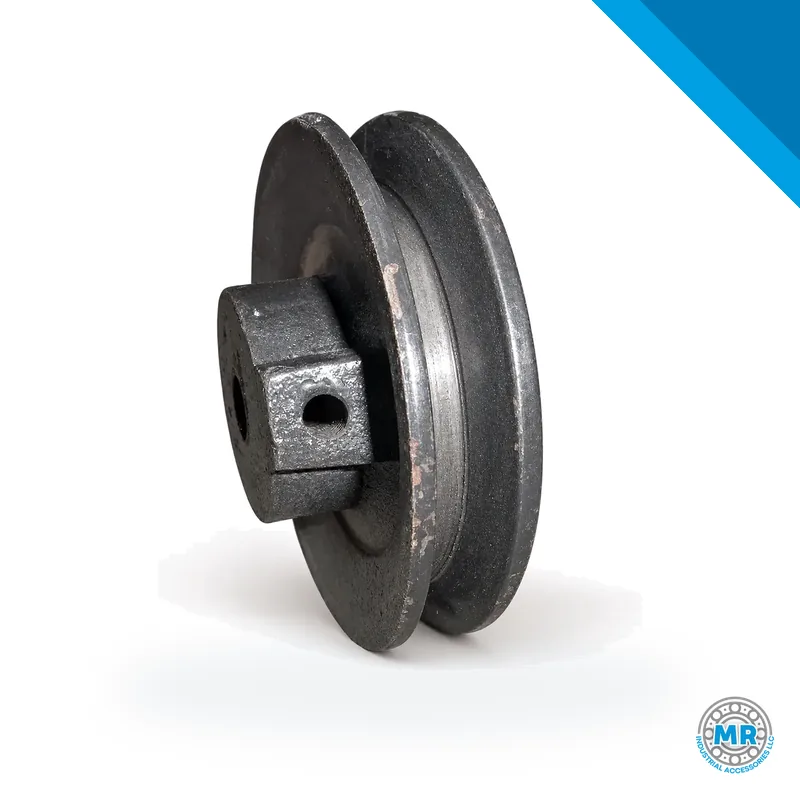

Industrial pulley 120 mm, 1 groove, section C
- Brand
- EMMAR
- Category
- Power transmission
- Subcategory
- Pulleys
- Section
- C
- Series
- Sección C
We reply promptly.
Tell us the quantity you need and request a quote by WhatsApp or email.
Can't find the exact model? Tell us the part number or model you need. We'll track it down and quote it, whether or not it appears in our catalog.
Description
EMMAR POLEA 120 1C belongs to pulleys, part of our Power transmission range. Tell us how many you need by WhatsApp or email and we'll get back to you promptly with a quote for POLEA 120 1C and any equivalents.
This EMMAR pulley measures 120 mm across and carries a single C-section groove. It transfers motion between parallel shafts using a V-belt, which makes it a practical choice for drives that call for a straightforward, dependable speed ratio. With one groove and a 120 mm diameter, it fits low-to-medium power setups. Because EMMAR produces it in-house, you can also ask about machining variations to suit your equipment.
The part is identified by three key figures: 120 mm diameter, one groove, and C section. C section is a V-belt profile that sits above A and B in size, so it appears in drives that need greater torque capacity. Having only one groove means a single belt runs in the sheave, which keeps installation and alignment simple. The 120 mm diameter works together with the driven pulley to set the transmission ratio. As an EMMAR-made component, it serves as a replacement for a worn pulley or as a building block for a new drive.
You will find this pulley on industrial equipment such as compressors, fans, centrifugal pumps, conveyor belts, and other general drive systems. It also shows up in agro-industrial settings and maintenance shops where pulleys are swapped out due to groove wear or a change in ratio. Since it is C section, it is typical in medium-power machines where the belt has to handle varying loads. If your original setup uses a 120 mm pulley with one C groove, this part can be a direct replacement, provided the shaft diameter and keyway type line up.
Proper mounting starts with checking that the shaft diameter matches the pulley bore and that the keyway is compatible. Pulley alignment matters to prevent belt wear and vibration. Belt tension should follow the equipment manual: too loose and it slips, too tight and it overloads the bearings. When a taper bushing is used, apply the torque specified by the bushing maker. In drives with multiple grooves, the number of grooves must equal the number of belts. If anything is unclear, reach out to the MR technical team.
Need a different size, groove count, or section? You can request an equivalent. Just send the current part number, the number of grooves, the belt section, and the pulley outer diameter. A photo of the part and the shaft size also help. With that information, MR checks whether an in-house manufactured pulley fits or whether a variant should be machined. The goal is to keep your equipment running without the hassle of an unavailable pulley.
To get a quote for this MR pulley—120 mm, one groove, C section—message us on WhatsApp and include the part number MR-POLEA-C1-120. If you are unsure about equivalence with the pulley you are replacing, also send the shaft and keyway dimensions. The MR Industrial Accessories team will provide the technical details you need to order the right part.
Dimensions
- Size
- 120mm
- Grooves
- 1
- Section
- C
Frequently asked questions
- What does section C mean?
- Section C is a V-belt profile larger than sections A and B. It is used in medium-power drives where the belt must transmit more torque. The pulley groove is machined to seat this belt correctly.
- Can I replace a pulley from another brand with this one?
- Yes, as long as the outer diameter, number of grooves, belt section, and shaft diameter with keyway match. If you have the original pulley part number, send it via WhatsApp and we will verify the equivalence.
- How do I request a pulley with a different size?
- Send via WhatsApp the diameter you need, the number of grooves, the belt section, and the shaft diameter. With that data we evaluate whether an in-house manufactured pulley is available or if a variant should be machined.